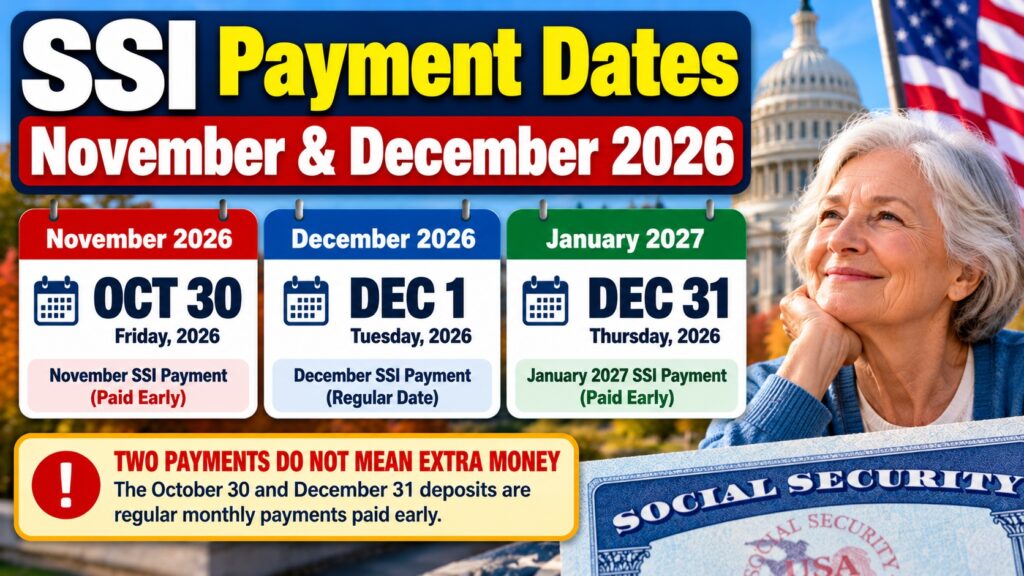

SSI Payment Dates November & December 2026
Last reviewed: October 26, 2026 | Country: United States | Program: Supplemental Security Income
These early deposits are regular monthly benefits, not additional bonus payments.
Supplemental Security Income provides monthly financial support to eligible people with limited income and resources who are aged 65 or older, blind, or have qualifying disabilities.
For beneficiaries who depend on SSI to pay rent, buy groceries, cover transportation, or purchase essential medical supplies, knowing the payment schedule is particularly important near the end of the year.
November and December 2026 include unusual deposit timing that can make it appear as though beneficiaries are receiving two payments in a single calendar month.
This guide explains the official SSI payment dates, why some deposits arrive early, maximum benefit amounts, eligibility requirements, the 2027 cost-of-living adjustment, and what to do if an expected payment does not arrive.
What Are the SSI Payment Dates for November and December 2026?
SSI is generally scheduled for the first day of each month. When that date falls on a Saturday, Sunday, or federal holiday, the Social Security Administration sends the payment on the preceding business day.
| Benefit Month | Actual Payment Date | Reason |
|---|---|---|
| October 2026 | October 1, 2026 | Regular monthly payment |
| November 2026 | October 30, 2026 | November 1 falls on Sunday |
| December 2026 | December 1, 2026 | Regular monthly payment |
| January 2027 | December 31, 2026 | January 1 is a federal holiday |
These dates are listed in the official Social Security Administration payment calendar.
View the official SSA payment calendars.
Why Is the November 2026 SSI Payment Arriving in October?
November 1, 2026, falls on a Sunday. Under federal payment scheduling rules, SSI benefits cannot be routinely issued on that Sunday.
Instead, the SSA schedules November’s SSI deposit for the last business day before November begins: Friday, October 30.
October 30, 2026
Friday — payment for the November benefit month.
Recipients who receive SSI by direct deposit should normally expect their payment according to the official schedule.
The exact time funds appear can depend on the bank or payment provider.
Beneficiaries should avoid assuming that a payment will always be available at midnight.
Will SSI Recipients Get Two Payments in October 2026?
Yes. Many SSI recipients will see two regular benefit deposits during October 2026.
The first is the October benefit paid on October 1. The second is the November benefit paid early on October 30.
| Deposit Date | Benefit Month Covered |
|---|---|
| October 1, 2026 | October 2026 |
| October 30, 2026 | November 2026 |
This distinction is especially important for people who use automatic bill payments or manage household expenses on a monthly budget.
Spending both October deposits before November begins could leave insufficient money for November essentials.
When Will SSI Be Paid in December 2026?
December SSI benefits are scheduled for Tuesday, December 1, 2026.
Because December 1 is a normal business day, no weekend or federal holiday adjustment is required.
However, recipients will see another SSI deposit later in December.
That second payment is scheduled for December 31 and represents the January 2027 benefit.
Why Will SSI Be Paid Twice in December 2026?
January 1, 2027, is New Year’s Day, a federal holiday.
Therefore, the January SSI payment is moved to the preceding business day, December 31, 2026.
| December Deposit | What It Covers |
|---|---|
| December 1, 2026 | December SSI benefit |
| December 31, 2026 | January 2027 SSI benefit |
This means eligible recipients may receive two deposits during December, but they still represent two separate monthly benefit periods.
The December 31 deposit should be budgeted for January expenses, not treated as an additional holiday payment.
How Much Is the Maximum SSI Payment in 2026?
The Social Security Administration sets annual maximum federal SSI benefit rates.
For 2026, the maximum federal monthly SSI payments are:
| SSI Recipient Category | 2026 Maximum Federal Monthly Amount |
|---|---|
| Eligible individual | $994 |
| Eligible couple | $1,491 |
| Essential person increment | $498 |
The essential person amount is a special increment under applicable SSI rules, not a separate payment available to every recipient.
The figures above represent maximum federal amounts before individual adjustments.
Your actual SSI payment may be lower depending on countable income, living arrangements, household circumstances, and other program rules.
Some states also provide supplemental payments that may increase the total amount received.
Check official SSI payment amounts.
Will SSI Payments Increase in January 2027?
The adjustment applies to federal SSI payment rates beginning with January 2027 benefits, which are scheduled to be paid on December 31, 2026.
As a result, the maximum federal SSI amount for an eligible individual increases from $994 in 2026 to $1,029 in 2027.
For an eligible couple, the maximum increases from $1,491 to $1,544.
| Recipient | 2026 Maximum | 2027 Maximum |
|---|---|---|
| Individual | $994 | $1,029 |
| Eligible couple | $1,491 | $1,544 |
| Essential person increment | $498 | $516 |
The actual increase received by an individual may differ because SSI is income-tested and depends on personal circumstances.
Read the official SSA COLA announcement.
Who Is Eligible for Supplemental Security Income?
SSI is intended for eligible individuals with limited income and resources who meet specific age, blindness, or disability requirements.
Generally, applicants must meet the following conditions:
- Be at least 65 years old, blind, or have a qualifying disability.
- Have limited income under SSI program rules.
- Have limited countable resources.
- Meet applicable citizenship or eligible noncitizen requirements.
- Meet the program’s U.S. residency and presence requirements.
- Comply with applicable SSA reporting and eligibility requirements.
Children with qualifying disabilities may also be eligible for SSI, subject to household income and resource rules.
Unlike Social Security Disability Insurance, SSI does not generally require a qualifying employment history.
Official SSI eligibility requirements.
What Are the SSI Resource Limits in 2026?
For most applicants, the standard countable resource limits remain:
| Household Category | Countable Resource Limit |
|---|---|
| Individual | $2,000 |
| Eligible couple | $3,000 |
Resources can include cash, bank balances, certain investments, and other assets that SSA considers countable.
However, not every asset counts toward the resource limit.
For example, a home used as a principal residence and certain other resources may be excluded under SSI rules.
Some specialized savings arrangements, including qualifying ABLE accounts, have separate treatment.
Applicants should review the complete SSA resource rules rather than assuming that every dollar of personal property is counted.
How Does Working Affect Your SSI Payment?
SSI recipients may be able to work while continuing to receive some benefits.
However, countable earnings can reduce the amount of the monthly SSI payment.
SSA generally applies income exclusions before calculating the reduction.
Under the standard earned-income calculation, approximately one dollar of SSI is reduced for every two dollars of countable earnings after applicable exclusions.
Income from pensions, unemployment compensation, and other non-work sources may be treated differently.
Recipients should report changes in employment and earnings promptly to avoid incorrect payments or future overpayment assessments.
Does Living With Family Affect SSI Benefits?
Living arrangements can influence the amount of SSI a person receives.
For example, if someone lives in another person’s home and receives certain shelter support without paying their required share, SSA may apply an in-kind support and maintenance reduction.
For 2026, the maximum reduction under the presumed maximum value rule is $351.33, although the actual treatment depends on the facts.
Not every person who lives with family automatically receives a reduction.
SSA considers the type of support provided, household expenses, and applicable exclusions.
Recipients should report relevant living arrangement changes to SSA.
How Can You Check Your SSI Payment Date?
The Social Security Administration offers online account services that can help beneficiaries review their payment information.
You can use the official my Social Security website to access available benefit details.
Depending on your account and benefit type, you may be able to review:
- Upcoming benefit payment information.
- Previous benefit payments.
- Benefit verification letters.
- Available personal and contact information.
- Eligible direct deposit details.
Never enter your Social Security number, password, or banking credentials into an unofficial payment-tracking website.
What Time Will SSI Direct Deposit Arrive?
The SSA publishes official payment dates but does not guarantee that every bank will display the deposit at exactly the same hour.
Some financial institutions offer early direct deposit as a customer service feature.
However, early availability depends on the institution and is not guaranteed by SSA.
Beneficiaries should plan around the official payment date instead of assuming funds will arrive several days early.
What Should You Do If Your SSI Payment Is Missing?
If an expected SSI payment has not appeared, confirm that the scheduled payment date has arrived and that you remain eligible for the benefit.
For direct deposit, SSA advises contacting your bank or financial institution first.
- Confirm the payment date: Check the official SSA calendar.
- Review your bank transactions: Look for an electronic federal benefit deposit.
- Contact your financial institution: Ask whether a deposit is pending or delayed.
- Check your SSA notices: Look for information about a benefit change, suspension, or overpayment adjustment.
- Contact SSA: If the payment remains missing, call 1-800-772-1213 or contact your local Social Security office.
For payments delivered by mail, different reporting and delivery procedures may apply.
Beneficiaries should use official SSA channels when reporting missing payments or updating banking information.
Can SSI Payments Be Delayed or Reduced?
Yes. Payment changes can occur when eligibility information changes or when SSA identifies a reporting or payment issue.
Common circumstances include:
- Changes in countable income.
- Changes in living arrangements.
- Changes in marital status.
- Changes in countable resources.
- Overpayment recovery.
- Failure to provide requested eligibility information.
A change in payment amount does not necessarily mean the government has changed the maximum federal SSI rate.
Recipients should review their official benefit notices for the reason and follow the applicable reconsideration or appeal process if they disagree with an SSA decision.
How Should SSI Recipients Budget for November and December?
The unusual year-end payment schedule can make household budgeting more difficult.
For example, a recipient may receive November’s money on October 30, then wait until December 1 for the next regular SSI benefit.
Similarly, the December 31 payment is intended to cover January 2027 expenses.
- October 1 deposit: $900 for October expenses.
- October 30 deposit: $900 for November expenses.
- December 1 deposit: $900 for December expenses.
- December 31 deposit: January 2027 entitlement, which may differ because of COLA or personal circumstances.
The amounts above are illustrative, not guaranteed SSI payments.
Recipients may find it helpful to separate money for rent, utilities, groceries, transportation, and medications before using the remainder for discretionary spending.
It is also wise to check automatic payment dates for bills that normally come due on the first of the month.
Is There an Extra SSI Bonus in December 2026?
The normal SSI payment calendar does not establish a universal Christmas bonus or an additional year-end stimulus payment.
The December 31 deposit represents the January 2027 SSI benefit paid early because of New Year’s Day.
It is not a second December benefit.
Verify all payment announcements directly through SSA.gov.
Official Social Security Administration Resources
Use these federal government resources to verify payment dates, benefit amounts, and eligibility:
- Official Social Security and SSI Payment Calendar
- SSI Maximum Payment Amounts
- SSI Eligibility Requirements
- SSI General Program Information
- Official Cost-of-Living Adjustment Information
- View Your Benefit Payment Schedule
- November SSI benefits are paid on October 30, 2026.
- December SSI benefits are paid on December 1, 2026.
- January 2027 SSI benefits are paid on December 31, 2026.
- Two deposits in October or December do not automatically mean extra benefits.
- The 2026 maximum federal SSI amount is $994 for an individual.
- The announced 2027 COLA is 3.6%.
- Use SSA.gov to verify personal payment information.
Editorial disclaimer: Seminarsonly.com is an independent informational publication and is not affiliated with the Social Security Administration or the United States government. This article is based on official SSA information reviewed on October 26, 2026. Individual eligibility, payment amounts, and deposit dates should be confirmed through official SSA records.