
By Anup V Naik | Updated July 9, 2026 | Fact-checked against DOJ and Britannica records
Rick Scott’s name comes up almost every election cycle tied to one phrase: Medicare fraud. But what actually happened at Columbia/HCA in the 1990s, how much money was involved, and was Scott himself ever charged? Here is what the public record actually shows.

Quick answer
Rick Scott co-founded Columbia Hospital Corporation, which grew into Columbia/HCA, the nation’s largest for-profit hospital chain. In 1997, the FBI raided company facilities as part of a Medicare and Medicaid fraud investigation, and Scott resigned as CEO under board pressure four months later. Columbia/HCA eventually pleaded guilty to 14 felonies and paid a total of 1.7 billion dollars in fines, penalties, and damages, then the largest health care fraud settlement in US history. Scott himself was never criminally charged.
What the Columbia/HCA fraud case actually involved
Rick Scott co-founded Columbia Hospital Corporation in 1987 after working as a law firm partner. The company grew rapidly by buying up hospitals across the country, and in 1994 it merged with Hospital Corporation of America to form Columbia/HCA, which became the largest for-profit health care company in the United States.
On March 19, 1997, agents from the FBI, the IRS, and the Department of Health and Human Services served search warrants at Columbia/HCA facilities in El Paso, Texas, and at the offices of doctors connected to the company. The investigation eventually expanded nationwide.
Federal investigators, working from complaints filed by internal whistleblowers, found that Columbia/HCA had engaged in multiple fraudulent billing practices, including:
- Inflated diagnosis coding, exaggerating how serious patients’ conditions were to increase Medicare reimbursements
- Illegal kickbacks to physicians in exchange for patient referrals, including partnership stakes, free office space, and other incentives
- False cost reports that claimed marketing and other non-reimbursable expenses as if they were patient care costs
- Fraudulent home health care billing, disguising the purchase price of home health agencies to shift costs onto Medicare
The company ultimately admitted to roughly ten distinct types of fraudulent conduct across its hospitals and subsidiaries.
Rick Scott’s role and resignation
Scott was chairman and CEO of Columbia/HCA when the investigation became public. Roughly four months after the initial raids, in July 1997, the company’s board pressured him to resign. Thomas F. Frist Jr. took over as chairman and CEO and publicly committed the company to cooperating with federal investigators, a notable shift from the company’s earlier posture.
Key facts about Scott’s departure and its terms:
- Scott has said he wanted to contest the federal allegations, while the board wanted to settle, and that this disagreement contributed to his exit
- He received a severance package reported at roughly 9.88 million dollars in cash
- He left holding an estimated 10 million shares of Columbia/HCA stock, worth several hundred million dollars at the time
- The FBI had reportedly viewed Scott as a subject of interest early in the probe, though this never resulted in charges against him
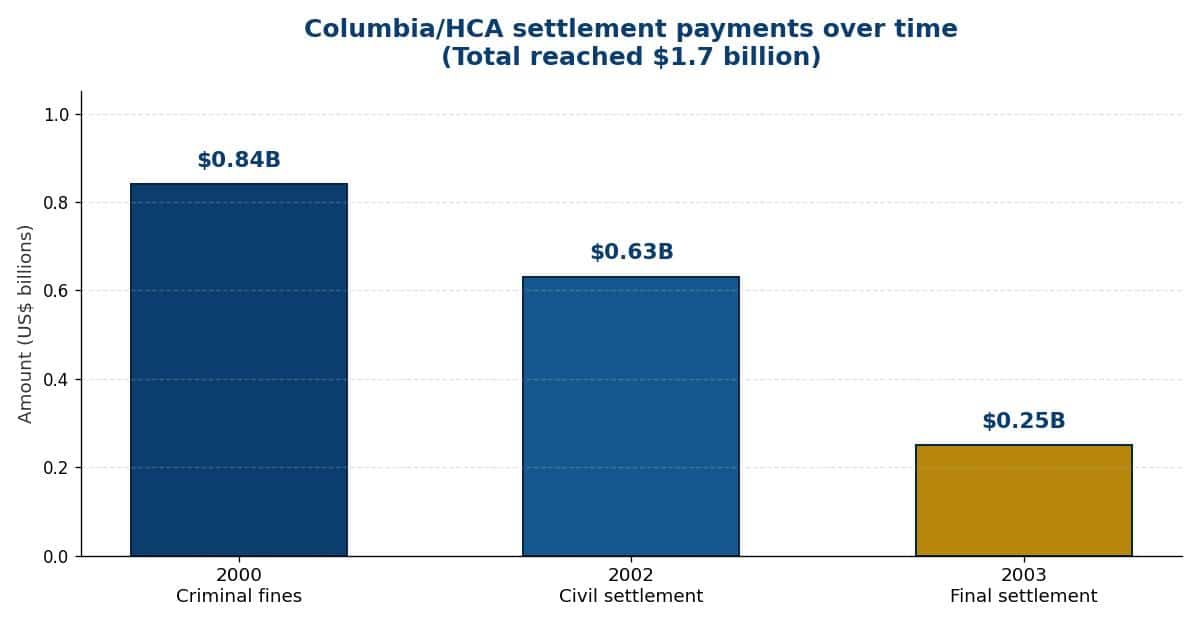
Chart: Columbia/HCA settlement payments by phase, totaling 1.7 billion dollars
The settlement, year by year
The Columbia/HCA case did not resolve in a single payment. It unfolded across several settlements between 2000 and 2003, after Scott had already left the company.
| Year | Settlement type | Amount |
|---|---|---|
| 2000 | First criminal and civil settlement | 840 million dollars |
| 2002 | Additional civil settlement | 631 million dollars |
| 2003 | Final wound care and related claims | Remaining balance to reach total |
| Total | Criminal fines, civil penalties, and damages combined | 1.7 billion dollars |
The Department of Justice called this the largest health care fraud settlement in US history at the time, though it has since been surpassed by later pharmaceutical settlements. Two whistleblowers, James Alderson and John Schilling, split a combined 100 million dollars, the largest qui tam whistleblower award paid out by the government up to that point.
Was Rick Scott personally charged
This is the detail most often left out of political attack ads: Rick Scott was never criminally charged in the case. Four Columbia/HCA executives were indicted. Two were convicted of defrauding Medicare in 1999, though those convictions were later overturned on appeal. A third was acquitted, and the jury could not reach a verdict on the fourth.
Scott has consistently said he was not aware of the fraudulent billing practices while he led the company. Company insiders offered mixed views. One outside attorney brought in to review compliance issues said he did not believe Scott personally approved illegal conduct, but suggested Scott likely understood what was happening given his hands-on management style. Scott has separately acknowledged that mistakes happened on his watch and said he accepts responsibility as the company’s former chief executive.
In a 2000 deposition tied to an unrelated civil matter, Scott invoked his Fifth Amendment right dozens of times, a fact that later became a recurring talking point in his political campaigns, even though invoking the Fifth is a legal right and not evidence of guilt.
Why it keeps resurfacing politically
The Columbia/HCA case has followed Scott through every major campaign since he entered politics:
- 2010 governor’s race: Opponents in both the Republican primary and general election raised the case; Scott won anyway
- 2014 re-election: The Florida Democratic Party called him “the ultimate Medicare thief,” a claim fact-checkers rated as broadly accurate on the settlement amount but noted the DOJ itself avoided the narrower term “Medicare fraud,” preferring “health care fraud,” since Medicaid and other programs were also involved
- 2018 Senate race and beyond: Democratic-aligned ads have continued referencing the case, including claims that Scott “walked away with millions,” which is consistent with his reported severance and stock holdings
Independent fact-checkers have generally found the core facts accurate: the company pleaded guilty, the fines were record-setting, and Scott was CEO throughout the period under investigation. What remains genuinely unresolved, and what fact-checkers are careful to flag, is how much Scott personally knew and when, since that was never tested in a criminal court.
Related on this site: our recent NVIDIA financial analysis and our broader financial and legal news coverage.
Frequently asked questions
How much did Rick Scott personally pay in the settlement
Nothing. The 1.7 billion dollars was paid by the corporation, Columbia/HCA, not by Scott individually. Scott had already left the company when most of the settlements were finalized.
Did Rick Scott admit wrongdoing
Scott has acknowledged that mistakes occurred under his leadership and said he accepts responsibility as the former CEO, but he has not admitted personal knowledge of, or involvement in, the specific fraudulent billing schemes.
Is this the largest Medicare fraud case in history
It was the largest health care fraud settlement in US history at the time it was finalized. Later cases, mostly involving pharmaceutical companies, have since resulted in larger settlements, so it is no longer the single largest overall, though it remains the largest such settlement involving a hospital corporation.
TLDR
- Rick Scott co-founded and led Columbia/HCA, which was investigated for Medicare and Medicaid fraud starting in 1997
- Scott resigned under board pressure four months after the FBI raids, with a severance package and stock worth hundreds of millions
- Columbia/HCA pleaded guilty to 14 felonies and paid 1.7 billion dollars in fines, penalties, and damages between 2000 and 2003
- Rick Scott himself was never criminally charged; four other executives were indicted, with mixed outcomes
- The case has resurfaced in every major Scott campaign since 2010 and remains politically contested regarding his personal knowledge
Sources: US Department of Justice settlement announcement, Encyclopaedia Britannica biography of Rick Scott.

About the Author
Anup V Naik is the founder of Wings Infotech and writes on financial, regulatory, and public interest topics. He holds a Mechanical Engineering degree from Manipal Institute of Technology and an MBA from TKM Institute of Management. This article draws on Department of Justice records and independent fact-checking sources; corrections are welcome via the comments section.

Pingback: Is PayYourBill.APSMedical.com a Scam? 2026 Investigation & Safety Guide - Seminarsonly.com