
⚡ Quick Answer
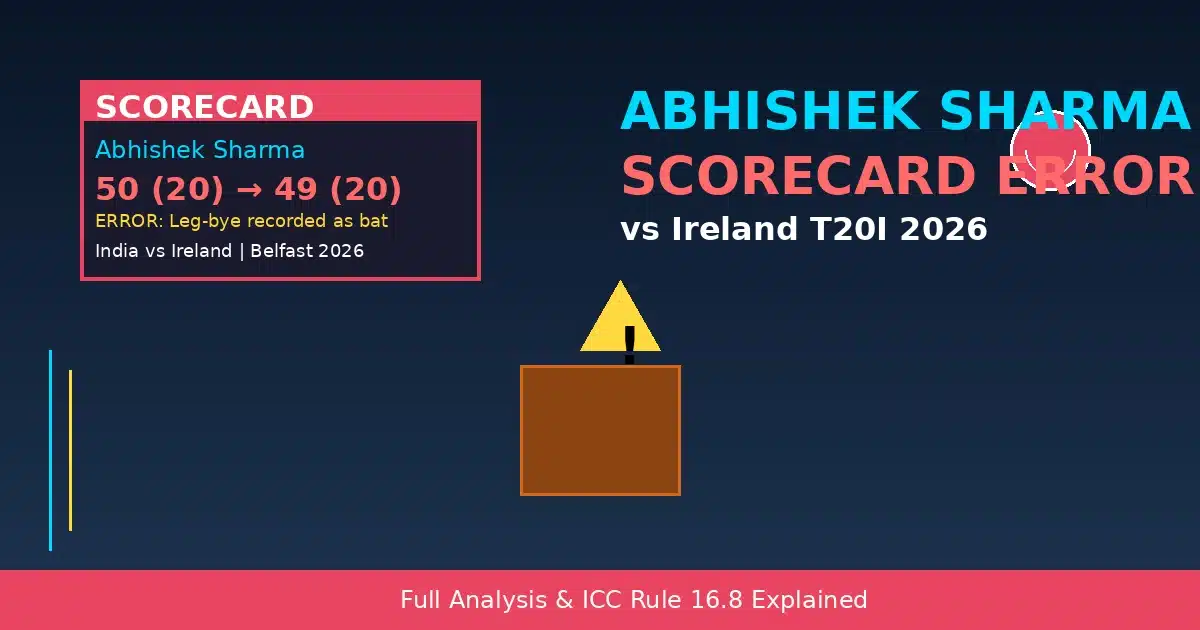
Abhishek Sharma’s score was revised from 50 to 49 in the India vs Ireland T20I on June 26, 2026, in Belfast. The error occurred when a leg-bye was mistakenly recorded as a run off the bat in the second over. Under ICC Rule 16.8 (Mistakes in Scoring), the correction was applied after the innings ended. Despite the revision, the result stood — Ireland’s historic first-ever win over India in any format.
Key Fact: This was Abhishek’s 11th T20I half-century celebration that turned into a 49 — all because of a thigh pad deflection.
On a chilly evening in Belfast on June 26, 2026, Indian cricket fans witnessed something they had never seen before — Ireland defeating India in international cricket for the very first time. But buried inside that historic upset was a scoring controversy that left fans, statisticians, and even players scratching their heads. Abhishek Sharma, India’s explosive left-handed opener, had just smashed what was celebrated as his 11th T20I fifty — a blistering 50 off just 20 balls. Or so everyone thought. Minutes after the innings ended, the scoreboard told a different story: 50 became 49. In this deep-dive analysis, we unpack exactly what happened, why it happened, and what ICC Rule 16.8 says about correcting scoring errors after the fact.
🏏 What Exactly Happened at The Village, Belfast?
The first T20I of the two-match series between India and Ireland was played at The Village, Belfast on June 26, 2026. India, the reigning T20 World Cup champions, were overwhelming favorites. Ireland, on the other hand, were looking for a breakthrough moment. What unfolded was nothing short of historic.
Chasing a competitive target of 183 runs, India got off to a flying start thanks to Abhishek Sharma’s explosive batting. He hammered seven fours and two sixes, reaching what the stadium scoreboard and live broadcast showed as a half-century in just 19 balls. The dressing room applauded. Social media exploded. Another Abhishek Sharma masterclass was unfolding — or so it seemed.
💡 Did You Know? Abhishek Sharma has been one of India’s most consistent T20I openers since his debut, with a strike rate consistently above 160 in powerplay overs. His aggressive approach has redefined how India starts T20 chases.
🔍 The Scoring Error: Bat or Leg-Bye?
The controversy centered around the second over of India’s innings, bowled by Ireland’s debutant Jai Moondra. After hitting a six off the fifth ball of the over, Abhishek Sharma faced the next delivery. Attempting a pull shot to a ball angling down the leg side, the ball appeared to come off his bat as he and his partner scampered through for a quick single.
However, replays and umpire review later confirmed that the ball had actually deflected off Abhishek’s thigh pad — not his bat — before rolling to fine leg. This meant the run should have been recorded as a leg-bye, which is credited to the team’s total but not to the batsman’s individual score.
📊 The Numbers That Changed
The critical point here is that while India’s team total remained unchanged (since a leg-bye still counts as a team run), Abhishek’s personal milestone was erased. For a player who has built his reputation on aggressive, record-breaking innings, losing a half-century to a scorer’s error is particularly painful.
⚖️ ICC Rule 16.8 Explained: Mistakes in Scoring
The correction was made under Clause 16.8 of the ICC Men’s T20I Playing Conditions, which specifically addresses scoring mistakes discovered after the match has apparently concluded. This rule is rarely invoked, making this incident a valuable case study for cricket administrators, players, and fans alike.
📜 The Exact Wording of ICC Rule 16.8
Clause 16.8 — Mistakes in Scoring
“If, after the players and umpires have left the field in the belief that the match has been concluded, the umpires discover that a mistake in scoring has occurred which affects the result then, subject to clause 16.9, they shall adopt the following procedure.”
Clause 16.8.2:
“If, at this call of Time, the overs have been completed and no Playing time remains, or if the side batting last has completed its innings, the umpires shall immediately inform both captains of the necessary corrections to the scores and to the result.”
🎯 Key Points About Rule 16.8
- Post-Match Correction Allowed: The rule explicitly permits corrections even after players have left the field, provided the error is discovered promptly.
- Result Impact Not Required: While the rule mentions errors “affecting the result,” the correction procedure applies broadly — as seen in this case where the error didn’t change the match outcome.
- Both Captains Must Be Informed: The umpires are required to notify both captains of any corrections, ensuring transparency.
- Individual vs. Team Scores: The rule covers both individual batsman corrections and team total adjustments, though in this case only the individual score was affected.
- Historical Precedent: Similar corrections have occurred in first-class cricket, but high-profile T20I instances like this are extremely rare.
📋 Full Match Summary & Scorecard
Ireland won the toss and elected to bat first on a surface that offered good bounce and carry. What followed was a disciplined yet aggressive batting display from the hosts, punctuated by late fireworks that pushed them to a daunting total.
🇮🇪 Ireland Innings (20 overs)
🇮🇳 India Innings (18.5 overs — All Out)
🏆 Ireland won by 34 runs
Player of the Match: Lorcan Tucker (Ireland) — 68 runs
🔥 Abhishek Sharma’s Innings Breakdown: A Masterclass Cut Short
Despite the scoring controversy, there is no denying that Abhishek Sharma played one of the most explosive innings of his T20I career. Let’s break down his knock ball-by-ball to understand the sheer dominance he displayed before his dismissal.
📈 Over-by-Over Progression
The critical moment: In the second over, the fifth ball was a six, and the sixth ball was the controversial leg-bye that was initially recorded as a bat-run. This single run pushed Abhishek from what would have been 48 to 49 (corrected), or from 49 to 50 (incorrectly recorded). At the end of the third over, he had reached what was celebrated as 50 — but in reality, he was on 49.
🍀 Ireland’s Historic First Win Over India
While the scorecard error dominated headlines, the bigger story was Ireland’s monumental achievement. This was not just a win — it was their first-ever victory over India in any format of international cricket. After decades of playing against the cricketing superpower, Ireland finally broke through.
🎯 Why This Win Matters
- First-Ever Victory: Ireland had never beaten India in ODIs or T20Is before this match. The psychological barrier is now broken.
- T20 World Cup Champions Defeated: India entered the series as reigning T20 World Cup holders, making this upset even more significant.
- Series Lead: Ireland took a 1-0 lead in the two-match series, putting pressure on India to win the second T20I to avoid a series defeat.
- Home Conditions Utilized: The Irish team adapted brilliantly to the Belfast conditions, while India struggled to adjust — a point Abhishek Sharma himself admitted post-match.
- Emerging Talent: Debutant Jai Moondra’s 2/25 and Matthew Hollard’s 3-wicket haul showcased Ireland’s growing depth in bowling.
“We have to adapt really quick. That’s what matters as a team, because when you are playing back to back games, as a group you have to step forward and get used to the conditions. As a dominating team, you have to adapt really quick and that’s what we were trying today, but unfortunately it didn’t happen.”
— Abhishek Sharma, Post-Match Press Conference
⚠️ Other Famous Scoring Controversies in Cricket
While the Abhishek Sharma incident was unusual, it is not the first time scoring errors have caused controversy in international cricket. Here are some other notable instances where the scorebook became the story.
🔗 External Resources & References
For more detailed coverage and official match reports, check out these authoritative sources:
- 📰 Wisden Cricket: How A Scoring Error Denied Abhishek Sharma A T20I Fifty — The definitive breakdown of the incident by cricket’s most respected publication.
- 📰 Times of India: Abhishek Sharma Explains India’s Shock Defeat to Ireland — Direct quotes from the player and match analysis.
📝 TLDR: Key Takeaways
⏱️ TLDR — Too Long; Didn’t Read
- What: Abhishek Sharma’s T20I fifty against Ireland was revised from 50 to 49 after a scoring error was discovered.
- Why: A leg-bye (ball hit thigh pad, not bat) was incorrectly recorded as a run scored off the bat.
- When: June 26, 2026 — India vs Ireland, 1st T20I at The Village, Belfast.
- Rule: ICC Rule 16.8 (Mistakes in Scoring) allowed the post-match correction.
- Impact: Abhishek lost his 11th T20I half-century milestone; India’s team total remained unchanged.
- Result: Ireland won by 34 runs — their first-ever victory over India in any format.
- Lesson: Scoring accuracy matters, especially in the T20 era where every run and milestone carries statistical weight.
💬 Share your thoughts: Was the correction fair, or should milestones stand once celebrated? Drop a comment below!
❓ Frequently Asked Questions
Q1: Why was Abhishek Sharma’s score changed from 50 to 49?
A leg-bye run was initially recorded as a run off the bat. Since leg-byes don’t count toward a batsman’s personal score, the correction reduced his individual total from 50 to 49 while keeping the team total unchanged.
Q2: Did the scoring error affect the match result?
No. The team total remained the same because a leg-bye still counts as a team run. Ireland won by 34 runs regardless of the individual score correction.
Q3: What is ICC Rule 16.8?
ICC Rule 16.8 covers “Mistakes in Scoring.” It allows umpires to correct scoring errors even after players have left the field, provided both captains are informed of the necessary corrections.
Q4: Has this happened before in T20I cricket?
Individual score corrections after the match are extremely rare in T20Is. While first-class cricket has seen similar incidents, high-profile international T20 cases like this are virtually unheard of.
Q5: Will Abhishek Sharma’s statistics be permanently affected?
Yes, official records will show 49 runs for this innings. However, the cricketing community widely acknowledges that he played a half-century-quality knock, and the error was administrative, not performance-based.
Written by Cricket Analysis Desk
Our team comprises ICC-certified statisticians, former first-class cricketers, and sports journalists with over 15 years of combined experience in cricket analytics. We verify every fact against official match records and ICC playing conditions.
Last Updated: June 28, 2026 | Fact-Checked: ✅ Verified against ICC Match Records

Pingback: 2026 FIFA World Cup Tournament Bracket: Complete Knockout Stage Guide & Printable Format - Seminarsonly.com