


By Freddy John | Updated July 9, 2026 | Verified against Chase’s official short code documentation
Got a text from the number 72166 claiming to be Chase? You are right to pause before reacting. Here is what that short code actually is, and how to tell a real Chase fraud alert from a scammer spoofing it.
Quick answer
72166 is a genuine short code that Chase uses to send fraud and account security alerts by text. Chase confirms this directly on its own website and through its official support account. However, scammers can spoof caller ID and short codes, so a text appearing to come from 72166 is not automatic proof it is real. If a message asks you to click a link, call a number in the text, or provide personal details, treat it as suspicious and verify by calling the number on the back of your Chase card instead.
What is 72166 and why Chase uses it
72166 is a five-digit SMS short code, not a regular phone number. Banks use short codes instead of normal 10-digit numbers so customers can recognize the same sender every time. Chase’s own support account has confirmed that fraud alert text messages are sent from short code 72166, alongside fraud alert emails from the domain chase@fraudalert.chase.com.
Chase’s official self-service page lists three short codes reserved for fraud and account security messages:
- 28107
- 36640
- 72166
You do not need to text STOP to each one separately. Texting STOP to any message you receive from these codes ends that alert thread.
Apple ID Account Alert Scam Text Message — How to Spot, Report & Avoid It (2026)
Why you received a text from 72166
Chase sends interactive texts from this short code for two main reasons:
- Potential fraudulent transaction: Chase asks you to confirm or deny a specific recent purchase
- Account security alert: Chase flags a suspicious login attempt or other unusual account activity
Up to ten messages may be sent for a single incident, and standard message and data rates apply.
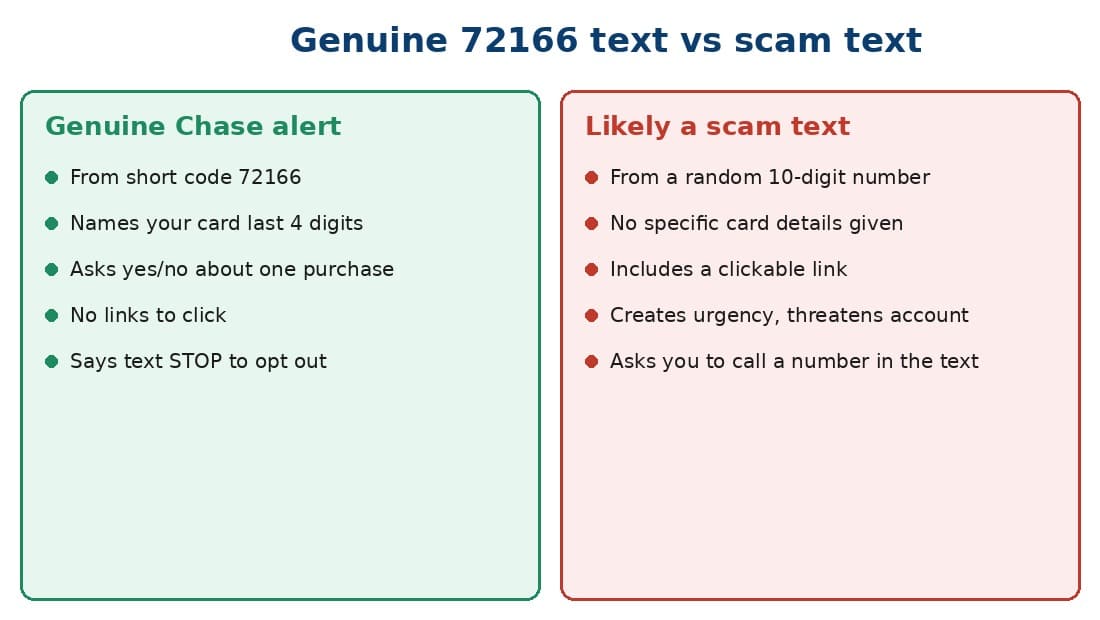
Side by side: what a genuine 72166 alert looks like versus a spoofed scam text
Genuine alert vs scam: side by side
| Signal | Genuine Chase text | Likely scam |
|---|---|---|
| Sender | Short code 72166, 28107, or 36640 | Random 10-digit number |
| Transaction detail | Names your card ending in specific digits | Vague or no specific details |
| Links | Rarely includes links | Pushes you to click a link |
| Tone | Simple yes or no question | Urgent, threatens account closure |
| Follow-up call | You call the number on your card | They ask you to call a number in the text |
How to verify the message is legitimate
Since 72166 is a real Chase number, but spoofing is possible, follow these steps every time:
- Do not click any link in the text message
- Do not reply with personal information such as your Social Security number or full account number
- Do not call a phone number provided inside the text
- Log in directly through the official Chase app or chase.com to check for alerts
- Call the number printed on the back of your Chase card to confirm with a real representative
Other Chase short codes to recognize
Beyond fraud alerts, Chase uses a handful of other short codes for different purposes. Recognizing these helps you tell routine account messages apart from anything suspicious:
- 63202: Primary phone number changes, one-time confirmation texts
- 85640: Card application status updates
- 98324 and 74869: General account review and update notifications
None of these should ever ask for your full card number, password, or Social Security number by text.
Related on this site: TCSG survey text scam red flags and our PayYourBill.APSMedical.com scam investigation.
Frequently asked questions
Is 72166 always Chase
72166 is genuinely registered to Chase for fraud alerts, but caller ID and short codes can be spoofed by scammers. The sender number alone is not enough proof, always verify through the app or the number on your card.
What should I do if I already replied or clicked a link
Call the number on the back of your Chase card immediately, change your online banking password, and monitor your account for unauthorized transactions. Consider also reporting the message to the FTC.
Can I stop these texts entirely
Texting STOP to any Fraud and Account Security message, or to 28107, 36640, or 72166 directly, ends that alert thread. You do not need to repeat this for each code separately.
TLDR
- 72166 is a real Chase short code for fraud and account security alerts, confirmed by Chase directly
- Scammers can spoof this number, so the sender alone does not prove a text is genuine
- Genuine texts name specific card details and rarely include links; scam texts push urgency and links
- Never click links or call numbers provided in the text itself
- Always verify by calling the number on the back of your physical Chase card
Sources: Chase official self-service text message documentation, FTC guidance on recognizing phishing scams.
About the author: Freddy John
Freddy John covers scam alerts, account security, and consumer fraud topics for Seminarsonly.com. This article draws on Chase’s own official short code documentation and FTC consumer guidance, and is updated as carrier and bank practices change. Corrections are welcome via the comments section.
