
Failed to Load IL2CPP? 9 Fixes to Get Your Game Running
Updated: September 2026 | Applies to: Windows Unity games and IL2CPP applications
Quick Answer: How to Fix Failed to Load IL2CPP
- Verify or repair the game’s files first. This can restore a missing or damaged
GameAssembly.dllor other required Unity files. - Check Windows Security or your antivirus quarantine for game files that may have been removed.
- Make sure GameAssembly.dll, UnityPlayer.dll and the game’s Data folder are present.
- Remove incompatible third-party mods or loaders and test the original game.
- If files remain missing or corrupted, perform a clean reinstall from the game’s official store/launcher.
- Developers should also check the DLL dependencies of GameAssembly.dll; Unity confirms that a missing dependent DLL can trigger this error.
The “Failed to load il2cpp” fatal error normally appears before a Unity game finishes starting. It means the Unity player could not successfully load the application’s IL2CPP runtime component. On Windows IL2CPP builds, GameAssembly.dll is especially important because Unity documents it as containing the IL2CPP runtime and generated script code. The fastest repair for a player is therefore to verify the installation before downloading random DLL files from the internet.
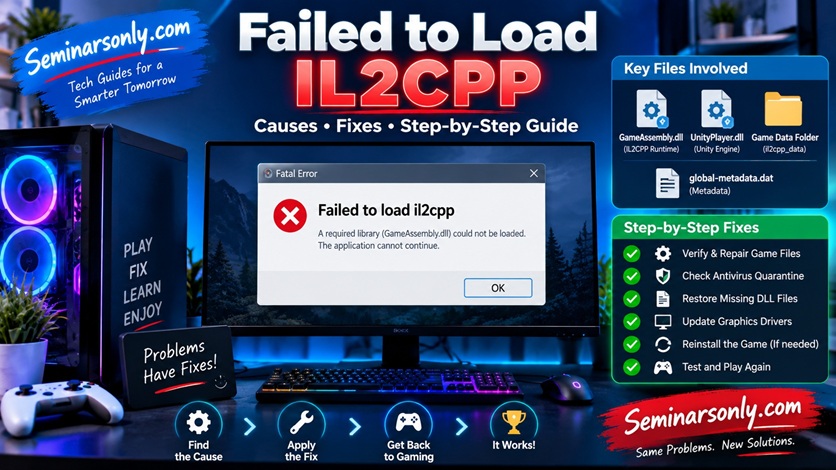
What Does “Failed to Load IL2CPP” Mean?
IL2CPP is a Unity scripting backend. At a simplified level, Unity converts managed application code to C++ and builds it into native code for the target platform.
In a Windows IL2CPP build, Unity normally produces several related components. One of the most important is:
Unity describes this file as the library containing the IL2CPP runtime and all of the application’s script code in a Windows IL2CPP build.
If Windows or Unity cannot load that component correctly, the application can stop almost immediately with:
Fatal error

Failed to load il2cpp
The important point is that the message does not identify one universal cause. A missing GameAssembly.dll can cause it, but so can a dependency that GameAssembly.dll needs in order to load.
Why Does Failed to Load IL2CPP Happen?
| Possible Cause | Typical Clue | Best First Fix |
|---|---|---|
| Corrupted game files | Error started after update/crash | Verify game files |
| Missing GameAssembly.dll | DLL absent from installation folder | Repair/reinstall game |
| Missing DLL dependency | GameAssembly.dll exists but will not load | Repair dependencies / developer diagnosis |
| Security software action | File disappeared or was quarantined | Review protection history |
| Mod incompatibility | Error began after installing/updating mods | Test clean game |
| Incomplete installation | Multiple game files are missing | Clean reinstall |
| Developer build issue | Fresh standalone build fails immediately | Inspect GameAssembly.dll dependencies |
Fix 1: Verify the Game Files First
For an installed game, this should usually be your first troubleshooting step. File verification compares the installed files with the publisher’s current distribution and replaces files that are missing or damaged.
For Steam Games
- Open Steam.
- Go to Library.
- Right-click the affected game.
- Select Properties.
- Open Installed Files.
- Choose Verify integrity of game files.
- Wait for verification to finish.
- Restart Steam and test the game.
If
GameAssembly.dll, UnityPlayer.dll or another packaged dependency was damaged or deleted, the launcher can restore the publisher’s correct copy automatically.Fix 2: Check Whether GameAssembly.dll Exists
Open the game’s installation directory and look for the files installed alongside the executable.
A typical Windows Unity IL2CPP installation may contain files resembling:
GameName.exe
GameAssembly.dll
UnityPlayer.dll
GameName_Data\
    il2cpp_data\
        Metadata\
            global-metadata.dat
Exact filenames and contents vary between games and Unity versions, but GameAssembly.dll is a key component of a typical Windows IL2CPP build.
The file is generated for the specific Unity application and contains its IL2CPP runtime and script code. Restore the correct version through the official launcher, installer or game publisher.
Fix 3: Check Windows Security or Antivirus Quarantine
If a required file suddenly disappears, review your security software’s recent actions before repeatedly reinstalling the game.
In Windows Security:
- Open Windows Security.
- Select Virus & threat protection.
- Open Protection history.
- Look for a recent action involving the affected game’s installation directory.
- If a legitimate game file was removed, verify the game through its official launcher after resolving the security-software issue.
Do not disable antivirus protection permanently just to make a game run. If security software repeatedly detects a file, verify that your copy of the game came from an official source and investigate the detection before creating exclusions.
Fix 4: Remove Mods and Test a Clean Installation
If Failed to load il2cpp started immediately after installing or updating a mod, plugin, injector or mod loader, test the original game without those modifications.
- Remove or disable recently added mods using their documented uninstall method.
- Restore the original files through the game launcher.
- Verify the installation again.
- Launch the unmodified game.
- If it works, check whether the mod supports the game’s current Unity/build version.
A game update can change native binaries and metadata, so a modification that worked with an earlier release may not necessarily be compatible with the new build.
Fix 5: Reinstall the Game Cleanly
If verification repeatedly fails or several required files are missing, perform a clean reinstall.
- Back up saves that are not cloud-synchronized.
- Uninstall the game through its launcher.
- Check whether leftover mod files remain in the old installation directory.
- Remove leftovers only when you are sure they are not needed saves or personal files.
- Restart Windows.
- Download the game again from its official source.
- Launch the clean installation before reinstalling mods.
Fix 6: Repair Required Microsoft Runtime Components
A native Windows game may depend on Microsoft runtime components. If a required runtime or native dependency is damaged or unavailable, Windows may be unable to load one of the DLLs needed during startup.
Use Microsoft’s official installers rather than third-party “DLL fixer” utilities. If the game’s publisher specifies a particular prerequisite, follow the publisher’s requirements.
Microsoft Visual C++ Redistributable Information
Fix 7: Restart Windows After an Update or Repair
If the error appeared immediately after a game, driver or Windows update, restart the computer before performing more invasive troubleshooting.
A restart clears old processes and ensures that newly installed runtime components and files are loaded into a fresh Windows session.
Fix 8: Check the Player.log for the Real Cause
The fatal-error dialog itself contains very little diagnostic information. Unity applications can write a Player.log containing more useful startup information.
Depending on the application and Unity version, Windows Unity logs are commonly stored under the user’s AppData\LocalLow area in a company/product folder.
Look near the end of the log for terms such as:
Failed to loadGameAssemblyil2cppDLLmoduledependency
Some very early startup failures may occur before a useful Player.log is created. In that case, file verification and native dependency checks become especially important.
Fix 9: Developer Fix — Check GameAssembly.dll Dependencies
If you are the Unity developer rather than a player, a successful build does not guarantee that every native dependency required at runtime was copied into the final player directory.
Unity documented a 2025 case where a standalone IL2CPP application displayed “Failed to load il2cpp” because a dynamic-library dependency required by the game’s library was not copied into the built player. Unity’s resolution was to ensure the required DLLs were present in the player root.
With the appropriate Visual Studio developer tools installed, developers can inspect dependencies with:
dumpbin.exe /dependents GameAssembly.dllThis is primarily a developer diagnostic. Ordinary players should not start downloading individual DLL files based on the output.
GameAssembly.dll Exists — Why Does IL2CPP Still Fail?
This is one of the most important troubleshooting distinctions.
The presence of GameAssembly.dll does not prove Windows can load it successfully. A DLL can exist on disk yet fail to load because one of its required native dependencies is unavailable or incompatible.
| Situation | What It Suggests |
|---|---|
| GameAssembly.dll is missing | Incomplete/corrupted installation or removed file |
| GameAssembly.dll exists but error remains | Check dependencies, file integrity and modifications |
| Error began after installing a mod | Test an unmodified installation |
| Error began immediately after game update | Verify files and update/remove incompatible mods |
| Developer build works on one PC only | Investigate runtime/native dependency packaging |
Failed to Load IL2CPP After a Game Update
If the game worked yesterday but fails immediately after an update, prioritize the following:
- Restart the launcher.
- Verify the game files.
- Disable/remove incompatible mods.
- Review antivirus protection history.
- Restart Windows.
- Check the game’s official support page for a known update issue.
Avoid applying old DLL replacements or files copied from a previous game version. Native Unity binaries are build-specific and mixing versions can create additional startup failures.
What Not to Do
- Do not download GameAssembly.dll from random DLL websites.
- Do not replace game binaries with files from another Unity game.
- Do not permanently disable antivirus protection.
- Do not assume graphics drivers are the primary cause without evidence.
- Do not reinstall Windows before trying file verification and a clean game reinstall.
- Do not mix DLLs from different versions of the same game.
- Do not install several “DLL fixer” applications hoping one will repair the error.
Quick Diagnostic Table
| What Happened? | Try This First | Then |
|---|---|---|
| Randomly stopped launching | Verify files | Check antivirus |
| GameAssembly.dll missing | Verify files | Clean reinstall |
| Started after mod installation | Remove mods | Verify files |
| Started after game update | Verify files | Update/remove mods |
| Fresh developer build fails | Check native dependencies | Inspect build packaging |
Quick Answers
What does Failed to load IL2CPP mean?
It means the Unity player could not successfully load the application’s IL2CPP runtime component during startup. On a typical Windows IL2CPP build, GameAssembly.dll contains the IL2CPP runtime and generated script code.
How do I fix Failed to load IL2CPP on Steam?
Start by using Steam’s Verify integrity of game files option. Then check antivirus protection history, remove incompatible mods and reinstall the game cleanly if verification does not repair it.
Can missing GameAssembly.dll cause Failed to load IL2CPP?
Yes. GameAssembly.dll is a key Windows IL2CPP build component. If the game’s copy is missing or corrupted, restore it through the game’s official installer or file-verification system.
Why does the error occur when GameAssembly.dll is already there?
A file can exist but still be impossible for Windows to load. One reason is a missing dependent DLL. Unity has documented a case where an IL2CPP standalone build failed because a dynamic-library dependency was not copied to the player folder.
Should I download GameAssembly.dll separately?
No. Restore the DLL using the official game launcher or installer. GameAssembly.dll is generated for the specific Unity application, so an unrelated copy is not an appropriate replacement.
Can mods cause Failed to load IL2CPP?
They can contribute to startup problems if a modification is incompatible with the current game build. If the error appeared after adding or updating mods, restore the original game and test it without modifications.
Technical Explanation: Why GameAssembly.dll Matters
Unity’s Windows IL2CPP documentation describes GameAssembly.dll as containing both the IL2CPP runtime and script code. This explains why the game can fail extremely early when that library—or something it requires—cannot be loaded.
A simplified startup path looks like this:
If loading the IL2CPP component fails at this early stage, Unity cannot proceed normally and may show the fatal-error dialog before the game reaches its menu.
Official Technical Reference
Unity’s documentation explains the files produced by Windows IL2CPP builds, including the role of GameAssembly.dll. Unity’s Issue Tracker also documents a modern case where an absent native DLL dependency caused the same startup error.
For more Windows, gaming and application troubleshooting guides, visit
SeminarsOnly Error Fix Guides
Final Failed to Load IL2CPP Checklist
- Restart the game launcher and Windows.
- Verify or repair the installed game files.
- Confirm GameAssembly.dll is present.
- Check Windows Security/antivirus protection history.
- Remove incompatible mods and test the original game.
- Repair official prerequisites if required by the publisher.
- Check Player.log for a more specific loading error.
- Perform a clean reinstall if the installation remains damaged.
- Developers: inspect GameAssembly.dll’s native dependencies and final build packaging.
Quick Answer: Failed to Load IL2CPP
- Fastest fix: verify or repair the game’s files.
- Check whether GameAssembly.dll is present.
- Review antivirus quarantine/protection history for removed game files.
- Remove incompatible mods if the error appeared after modifying the game.
- Do not download replacement GameAssembly.dll files from random websites.
- Clean-reinstall the game if verification cannot restore the correct files.
- If you developed the application, check GameAssembly.dll dependencies and make sure every required native DLL is included with the player.
Technical review note: This guide distinguishes between a missing GameAssembly.dll and a GameAssembly.dll that exists but cannot load because one of its dependencies is unavailable. That distinction is supported by Unity’s Windows IL2CPP documentation and Unity Issue Tracker.
Editorial policy: Troubleshooting steps prioritize reversible fixes—file verification, official installers and clean testing—before more invasive changes. Unity versions and individual game configurations differ, so game-specific publisher instructions should take priority where available.
