
By Freddy John, Consumer technology editor · Updated 25 June 2026 · 8 min read
If you buy a processor on Amazon, there is a small but real chance the sealed box holds an old chip, a wrong model, or even a 3D-printed dummy. It is called the Amazon CPU swap return scam, and it has hit buyers of premium parts like the Ryzen 7 9800X3D and Ryzen 9 9950X3D. This guide explains how it works, the warning signs, and exactly what to do to protect your money.
Quick answer
The Amazon CPU swap return scam happens when someone buys a real CPU, swaps in an old or fake chip, reseals the box, and returns it. Because Amazon pools stock from many sellers (commingled inventory), that tampered unit can ship to the next buyer as new. Protect yourself by inspecting the seal, weighing the box, matching the serial number, and filming the unboxing. If you receive a swapped chip, document it, contact Amazon, and open an A-to-z Guarantee claim. Amazon says it will end commingling by March 2026.
On this page
What the Amazon CPU swap return scam actually is
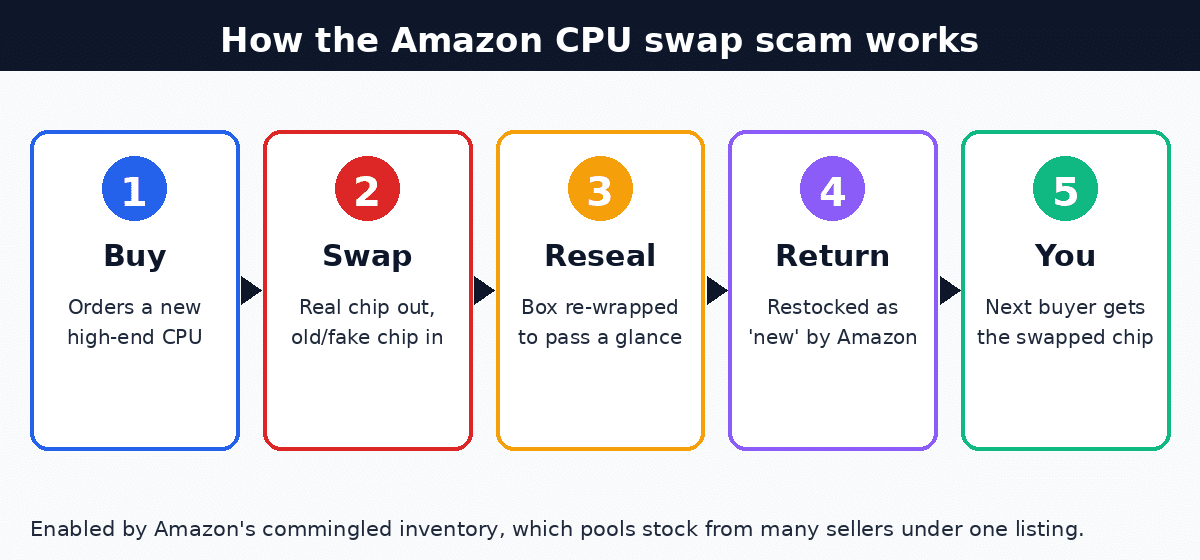
At its core this is a return-fraud trick. A scammer orders an expensive, in-demand processor, keeps the good chip, and puts something worthless back in the box. They reseal it well enough to pass a quick glance, then return it for a refund. The problem is what happens next: that box can quietly go back into Amazon’s general stock and get shipped to an honest buyer who paid full price for a new part.
Reported cases are not theoretical. One buyer opened a sealed Ryzen 7 9800X3D box and found an Intel Core i9-10900K inside. A reviewer in Germany received an old AMD FX-4100 in a sealed 9800X3D box. Another shopper who bought an open-box Ryzen 9 9950X3D got something with no real CPU at all, just a 3D-printed base topped with a genuine heat spreader to fool the eye and the warehouse scanner.
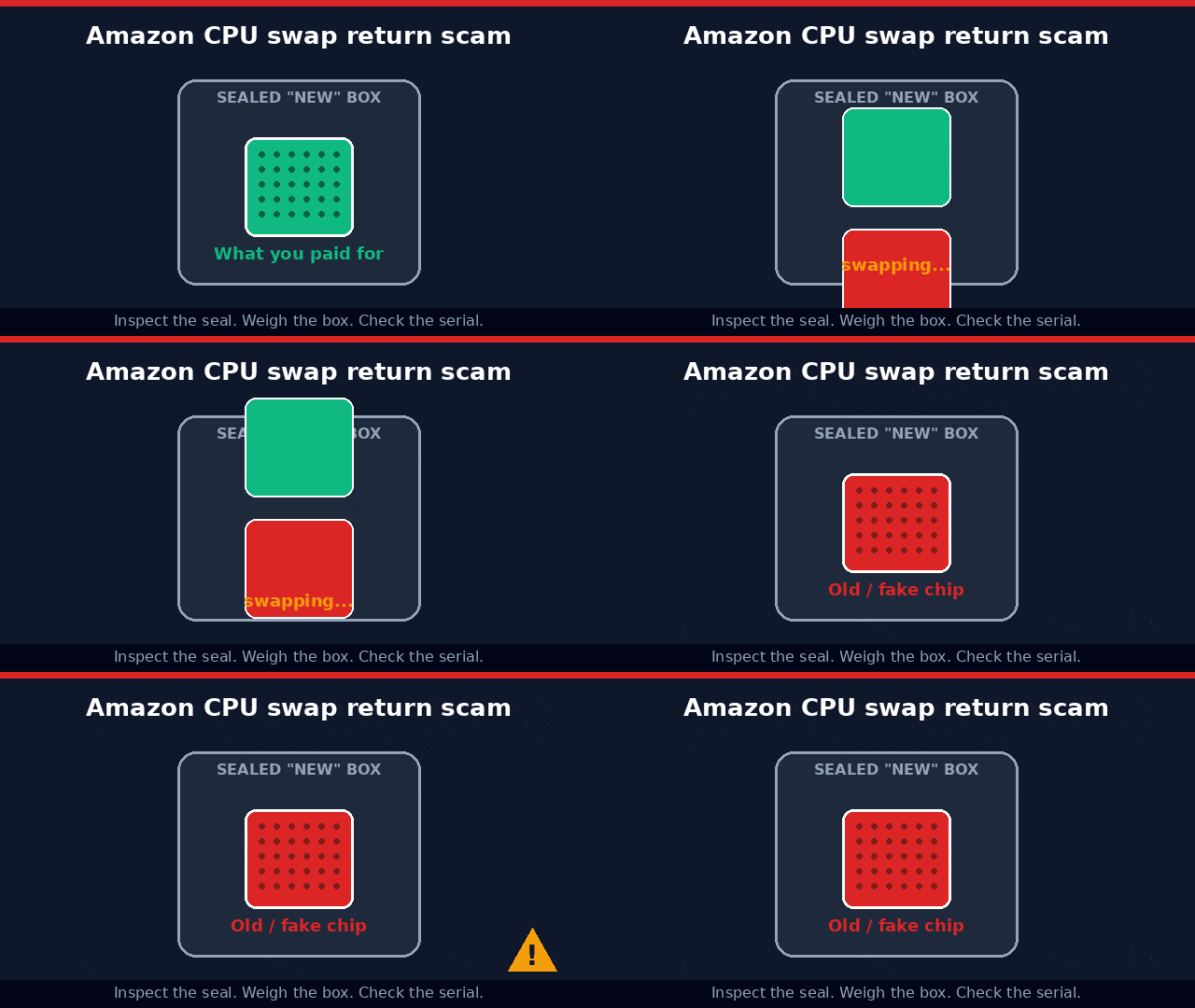
The swap in motion: a paid-for chip is replaced by an old or fake one, then resealed as new.
How the swap scam works, step by step
Here are the real reported cases that show the pattern, and how big the gap was between what people paid for and what arrived.
Why Amazon’s system makes this possible
The enabler is a practice called commingled inventory. To ship faster, Amazon has historically pooled identical items from many sellers under one listing without tracking each individual unit back to its seller. A tampered return that passes a visual check can drop straight back into that shared pool, so the next order pulls a compromised box.
Returns handling is the other weak point. Warehouse staff often restock items as new after a quick look, without verifying serial numbers against the original sale. That is why a resealed box, or a dummy with a genuine-looking heat spreader, can slip through.
Worth knowing: Amazon has said it plans to phase out commingling by March 2026. That should reduce this fraud over time, but as of now it has not stopped, so the checks below still matter.
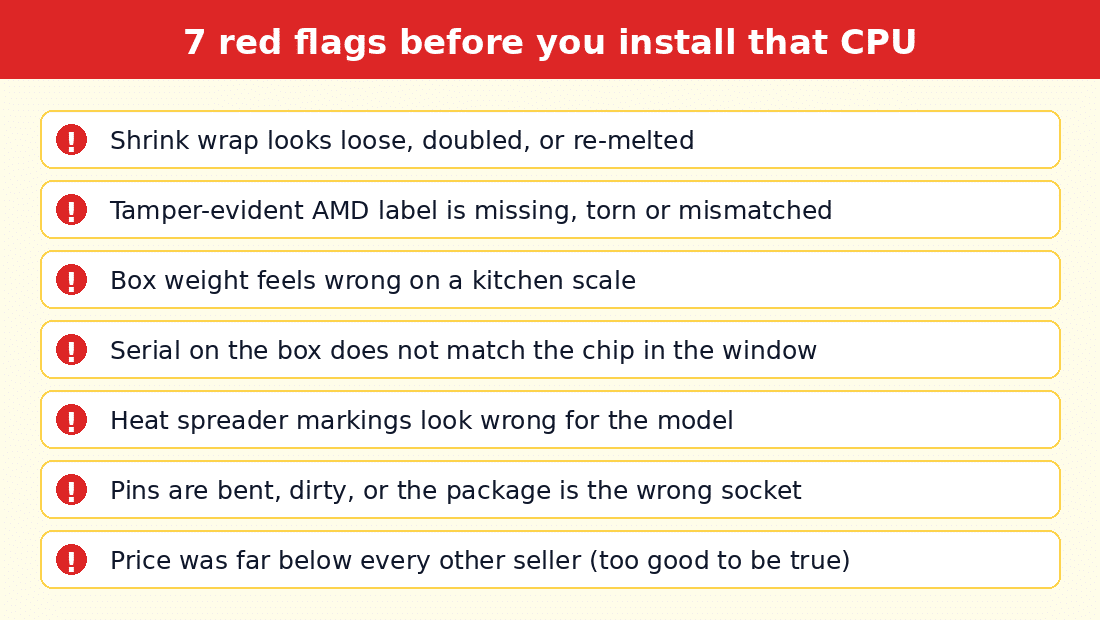
7 red flags to check before you open the box
Most swaps are caught in the first sixty seconds. Slow down before you tear into the packaging, and treat any one of these as a reason to stop, photograph, and contact Amazon rather than install.
How to inspect a CPU before you install it
Do these five checks in order. They take about five minutes and they are your best evidence if you need a refund later.
1. Film the unboxing in one take
Start recording before you cut the wrap and keep the box, label, and chip in frame. An unbroken video is the single most persuasive piece of proof in a dispute.
2. Inspect the seal and tamper label
Look for loose, doubled, or re-melted shrink wrap, and a tamper-evident label that is torn, missing, or does not line up. AMD retail boxes carry a secure authentication label with a serial and QR code.
3. Weigh the sealed box
A kitchen scale is enough. A swapped or dummy chip usually throws the weight off, since a different model or a plastic base will not match the genuine part.
4. Match the serial in the window
The serial visible through the box window should match the secure label exactly. A mismatch is a strong sign the contents were swapped.
5. Check the chip itself
Confirm the socket is right, the heat spreader markings match the model, and the pins or pads are clean and undamaged. Repackaged old chips and relabeled Intel parts often give themselves away here.
What to do if you received a swapped CPU
Stay calm and build a paper trail. The stronger your documentation, the faster this resolves.
- Stop and document. Do not install the chip. Photograph the seal, label, serial, and the chip from every angle, and keep that unboxing video.
- Contact Amazon right away. Open a support chat, explain that you received a different or tampered item, and reference your order number.
- Open an A-to-z Guarantee claim if needed. If the seller or support stalls, escalate through the A-to-z Guarantee for items that arrive materially different from the listing.
- Report the fraud. Report it to Amazon’s fraud channel. For high-value losses, a local police report can help, and it discourages scammers who rely on quiet refunds.
- Keep everything. Save the box, the label, and all chat transcripts until the refund clears.
Do not skip the evidence step. Because anyone could swap an item and try to return it, disputes often come down to who has the clearer proof. Photos plus an unbroken video tilt that heavily in your favor.
How to verify your CPU is genuine
For AMD parts, the serial and part number live on the tamper-evident label and in the box window. You can confirm both without installing the chip:
Buying CPUs safely from now on
You do not have to avoid Amazon entirely, but a few habits cut your risk sharply.
Frequently asked questions
Is the Amazon CPU swap return scam real?
Yes. There are multiple documented 2025 and 2026 cases of sealed boxes holding old, wrong, or fake processors, including a 3D-printed dummy fitted with a genuine heat spreader.
Why does Amazon ship swapped CPUs as new?
Commingled inventory pools stock from many sellers under one listing, so a resealed return can re-enter the pool. Amazon says it plans to end commingling by March 2026.
Can I get a refund if I received a swapped CPU?
Usually yes. Document everything with photos and video, contact Amazon, and if needed open an A-to-z Guarantee claim. Report suspected fraud, and consider a police report for large losses.
How do I check if a Ryzen CPU is genuine?
Match the serial in the box window to the tamper label, scan the QR code, and use AMD’s serial number lookup and validation tools to confirm the part number and warranty status.
TL;DR
- The Amazon CPU swap return scam puts old, wrong, or fake chips inside sealed boxes.
- Documented victims ordered parts like the 9800X3D and 9950X3D and got an i9-10900K, an FX-4100, or a 3D-printed dummy.
- Amazon’s commingled inventory and loose returns checks let tampered boxes ship as new.
- Before installing: film the unboxing, inspect the seal and label, weigh the box, match the serial, check the chip.
- If scammed: document, contact Amazon, open an A-to-z claim, report the fraud, keep all evidence.
- Amazon says commingling ends by March 2026; until then, the manual checks are your real protection.
About the author
Freddy John is a consumer technology editor who covers online shopping safety, hardware buying, and digital fraud. This guide is based on documented buyer reports and manufacturer authentication guidance, and is reviewed for accuracy on each update. It is general consumer information, not legal advice.
Sources and tools: AMD processor serial number lookup, AMD validation page, AMD boxed-processor authenticity guidance, and Amazon A-to-z Guarantee. Reported swap cases summarized from Tom’s Hardware, TweakTown, and Hardware Busters coverage (2025 to 2026).

Pingback: Fix Twitch Error #2000 “There was a Network Error. Please Try Again” - Seminarsonly.com