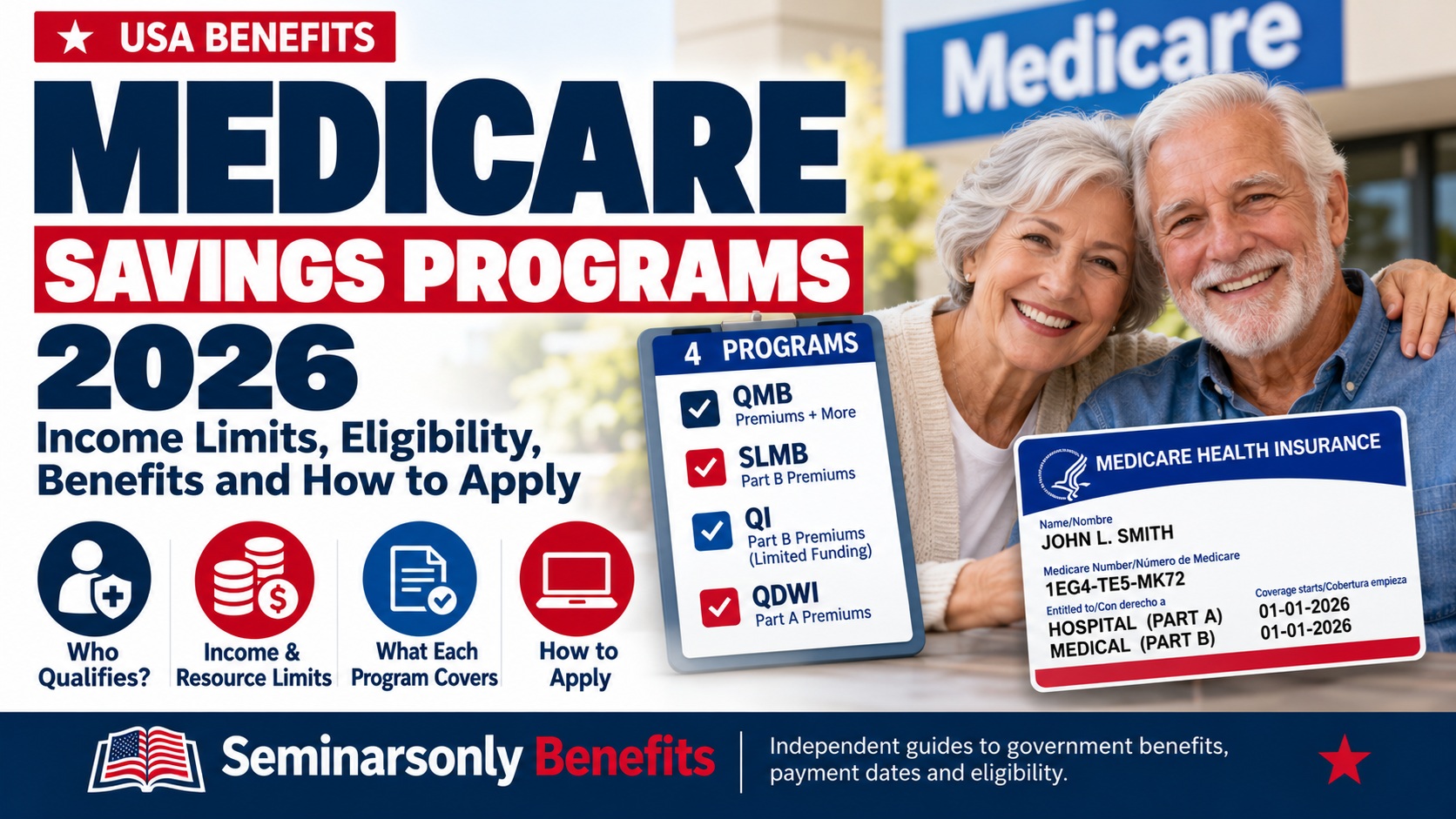
Medicare Savings Programs 2026: QMB, SLMB, QI and QDWI Income Limits
Quick Answer: Who Qualifies for Medicare Savings Programs in 2026?
- QMB: Individual monthly income limit of $1,350; helps pay Medicare Part A and Part B premiums and Medicare-covered cost sharing.
- SLMB: Individual monthly income limit of $1,616; helps pay Part B premiums.
- QI: Individual monthly income limit of $1,816; helps pay Part B premiums, subject to additional rules.
- QDWI: Individual monthly income limit of $5,405; helps certain working people with disabilities pay Part A premiums.
- Resource limits: $9,950 for individuals under QMB, SLMB and QI; $4,000 under QDWI.
- Where to apply: Your state Medicaid agency.
Important: These are the published federal 2026 figures. Your state may use more generous eligibility rules, and Alaska and Hawaii have higher income limits.
Medicare can provide important health coverage, but premiums and out-of-pocket costs can still place pressure on a household budget. For people with limited income and resources, a Medicare Savings Program (MSP) may help reduce those expenses.
There are four main programs: Qualified Medicare Beneficiary (QMB), Specified Low-Income Medicare Beneficiary (SLMB), Qualifying Individual (QI) and Qualified Disabled and Working Individuals (QDWI).
Each program has different income requirements and covers different Medicare costs. The program for which you qualify is determined by your state.
This guide explains the official 2026 federal limits, the differences among the programs, what resources may count, how Medicare Extra Help works and how to apply.
Medicare Savings Programs 2026 Income Limits
Medicare.gov publishes monthly income limits for each of the four Medicare Savings Programs. The amounts differ for individuals and married couples.
The table below presents the official federal figures for 2026.
| Program | Individual Monthly Income | Married Couple Monthly Income |
|---|---|---|
| QMB | $1,350 | $1,824 |
| SLMB | $1,616 | $2,184 |
| QI | $1,816 | $2,455 |
| QDWI | $5,405 | $7,299 |
Official reference: Medicare.gov — Medicare Savings Programs.
Do Medicare Savings Program Income Limits Include Social Security?
Social Security retirement and disability benefits may count as income when a state evaluates eligibility.
However, the amount counted for MSP purposes may not be identical to the full amount you receive each month. Applicable income disregards and state eligibility rules can change the calculation.
For example, CMS explains that its published federal MSP income limits incorporate a standard $20 disregard, while QDWI rules include earned-income disregards.
If your Social Security payment appears slightly higher than the federal limit, do not automatically assume you are ineligible. Submit an application and let the state determine your countable income.
Are the Limits Based on Gross or Net Income?
MSP eligibility uses program-specific countable-income rules rather than simply comparing your take-home pay with a table.
Income from Social Security, employment, pensions and other sources may be treated differently depending on the program and state.
Your Medicaid agency can explain how it counts each source and which deductions or exclusions apply.
Medicare Savings Programs 2026 Resource Limits
Along with income, some states assess countable resources, sometimes called assets.
The 2026 federal resource limits are:
| Program | Individual Resource Limit | Married Couple Resource Limit |
|---|---|---|
| QMB | $9,950 | $14,910 |
| SLMB | $9,950 | $14,910 |
| QI | $9,950 | $14,910 |
| QDWI | $4,000 | $6,000 |
These are federal reference limits. Some states use higher resource limits or eliminate the resource test for certain Medicare Savings Programs.
What Resources Usually Count?
Resources that may be evaluated include:
- Money in checking accounts.
- Money in savings accounts.
- Stocks and certain investment holdings.
- Bonds and other countable financial resources.
Rules can vary, so an asset that counts under one state or program may be treated differently under another.
What Resources May Be Excluded?
Under common federal eligibility rules, certain assets may be excluded, including:
- The home in which you live.
- One vehicle used for transportation.
- Household goods and personal belongings.
- Certain burial-related funds or arrangements.
Exclusions are subject to the applicable program and state rules. Do not sell or transfer property based only on a general resource list.
What Is the Qualified Medicare Beneficiary (QMB) Program?
The Qualified Medicare Beneficiary (QMB) program offers the broadest Medicare cost assistance among the four main MSP categories.
For eligible beneficiaries, QMB helps pay:
- Medicare Part A premiums, when applicable.
- Medicare Part B premiums.
- Deductibles for Medicare-covered services.
- Coinsurance for Medicare-covered services.
- Copayments for Medicare-covered services.
In 2026, the published federal monthly income limit is $1,350 for an individual or $1,824 for a married couple.
Can a Doctor Bill Someone Enrolled in QMB?
Federal law protects QMB beneficiaries from being billed for Medicare Part A and Part B cost sharing on Medicare-covered items and services.
This protection applies even when the provider does not participate in Medicaid.
Providers may not charge QMB beneficiaries Medicare deductibles, coinsurance or copayments for Medicare-covered services. A small Medicaid copayment may apply in certain circumstances.
The protection does not mean every health-related purchase or service is free. Non-covered services and applicable prescription drug costs may be treated differently.
What If You Receive an Incorrect Medicare Bill?
- Check that the service was covered by Medicare.
- Tell the provider’s billing department that you are enrolled in QMB.
- Show your Medicare and Medicaid or QMB identification, if available.
- Ask the provider to correct the bill.
- If the issue remains unresolved, contact Medicare or your State Health Insurance Assistance Program (SHIP).
If you already paid prohibited Medicare cost sharing, you may have a right to a refund.
CMS provides additional information about these protections on its QMB Program page.
What Is the Specified Low-Income Medicare Beneficiary (SLMB) Program?
The Specified Low-Income Medicare Beneficiary (SLMB) program helps eligible Medicare beneficiaries pay their Part B premiums.
Unlike QMB, SLMB does not generally pay Medicare deductibles, coinsurance or copayments.
For 2026, the published federal monthly income limits are:
- Individual: $1,616.
- Married couple: $2,184.
Applicants must have both Medicare Part A and Part B to qualify for SLMB.
How Much Could SLMB Save in 2026?
The standard Medicare Part B premium for 2026 is $202.90 per month, according to CMS.
For someone paying that standard premium, having SLMB cover it represents $2,434.80 over twelve months.
Actual savings depend on the beneficiary’s premium and the period of approved coverage.
People with higher income-related Part B premiums should ask their state which premium amount the program will pay.
Does SLMB Include Prescription Drug Help?
Yes. Medicare.gov states that people who qualify for SLMB also receive Medicare Extra Help for prescription drug costs.
Extra Help can reduce qualifying Part D plan expenses, including certain premiums and prescription cost sharing.
SLMB itself is a Part B premium assistance program, while Extra Help addresses eligible Medicare prescription drug costs.
What Is the Qualifying Individual (QI) Program?
The Qualifying Individual (QI) program also helps eligible beneficiaries pay their Medicare Part B premiums.
Its federal income limits are higher than the SLMB limits.
For 2026, the published federal monthly limits are:
- Individual: $1,816.
- Married couple: $2,455.
Applicants must have both Part A and Part B.
Do You Need to Reapply for QI Every Year?
Yes. Medicare.gov states that QI beneficiaries must apply every year to continue receiving benefits.
QI applications are approved on a first-come, first-served basis, with priority for people who received QI benefits during the previous year.
Because of this rule, eligible beneficiaries should contact their state agency about the renewal process rather than assuming coverage automatically continues.
Can You Receive QI and Full Medicaid?
QI is generally available only to people who do not qualify for other Medicaid coverage or benefits.
If you qualify for another Medicaid category, your state can determine whether a different Medicare Savings Program or Medicaid benefit applies.
QI beneficiaries also receive Extra Help with eligible Medicare prescription drug costs.
What Is the Qualified Disabled and Working Individuals (QDWI) Program?
The Qualified Disabled and Working Individuals (QDWI) program serves a narrower group of beneficiaries.
It may help certain people with disabilities who returned to work and lost premium-free Medicare Part A.
QDWI helps pay Medicare Part A premiums only.
The 2026 federal limits are:
| Applicant | Monthly Income Limit | Resource Limit |
|---|---|---|
| Individual | $5,405 | $4,000 |
| Married couple | $7,299 | $6,000 |
These higher income limits do not mean every Medicare beneficiary with earnings below the amounts qualifies.
QDWI generally requires the applicant to:
- Have a qualifying disability.
- Be working.
- Have lost Social Security disability benefits and premium-free Part A because of returning to work.
- Meet the applicable financial and program conditions.
QDWI is not a general program for all employed Medicare beneficiaries. Its eligibility requirements are tied to a specific disability and work situation.
QMB vs. SLMB vs. QI vs. QDWI: What’s the Difference?
The biggest difference among these programs is which Medicare expenses they pay.
| Program | Part A Premium | Part B Premium | Medicare-Covered Cost Sharing |
|---|---|---|---|
| QMB | Yes, when applicable | Yes | Yes |
| SLMB | No | Yes | No |
| QI | No | Yes | No |
| QDWI | Yes | No | No |
For people with very limited income, QMB may provide the greatest financial protection because it addresses both premiums and Medicare-covered cost sharing.
SLMB and QI are primarily designed to reduce Part B premium expenses. QDWI helps a specific group of working people with disabilities retain Part A coverage.
How Much Is the Medicare Part B Premium in 2026?
CMS confirms that the standard Medicare Part B premium for 2026 is $202.90 per month.
The standard annual Part B deductible is $283.
These amounts are separate from the Medicare Savings Program income limits.
For a beneficiary paying the standard premium, assistance with the full Part B premium could save approximately:
- Monthly: $202.90.
- Six months: $1,217.40.
- Twelve months: $2,434.80.
These are illustrative amounts, not guaranteed payments or cash benefits. MSP assistance generally pays qualifying Medicare costs rather than issuing that amount directly to the beneficiary.
Source: CMS — 2026 Medicare Part B Premiums and Deductibles.
What Is Medicare Extra Help?
Extra Help is a federal program that helps eligible Medicare beneficiaries with prescription drug costs under Medicare Part D.
Medicare.gov states that people qualifying for QMB, SLMB or QI also receive Extra Help.
In 2026, Medicare.gov lists a maximum copayment of $12.65 for each covered drug for people receiving these MSP-related Extra Help benefits.
The exact amount may be lower depending on the medication and the beneficiary’s circumstances.
Extra Help and MSPs are related but distinct programs. A person may qualify for prescription drug assistance even if they do not qualify for a particular Medicare Savings Program.
How to Apply for Medicare Savings Programs in 2026
Medicare Savings Programs are administered by states through Medicaid agencies.
You generally do not apply directly through a Medicare.gov enrollment form.
Step 1: Contact Your State Medicaid Agency
Visit the official Medicare Savings Programs page and use its state contact option.
Find Your State MSP Application Information
Ask specifically about applying for QMB, SLMB, QI or QDWI.
Step 2: Request an MSP Eligibility Review
Tell the agency you want to be screened for Medicare Savings Programs.
You do not need to know in advance which category fits your circumstances. Your state can review the relevant options.
If you already receive Medicaid, ask whether you are enrolled in an MSP or need a separate eligibility determination.
Step 3: Gather Required Documents
The agency may request information such as:
- Medicare card or Medicare number.
- Proof of identity and state residence.
- Social Security award letters or benefit statements.
- Pension or employment income records.
- Bank statements, if a resource test applies.
- Information about a spouse’s income and resources, if applicable.
- Other documents needed to verify eligibility.
The exact requirements depend on your state and circumstances.
Step 4: Submit the Application
States may accept applications online, by mail, over the phone or through local Medicaid offices.
Follow the submission instructions provided by your state agency and keep a copy or confirmation number.
Step 5: Respond to Verification Requests
Your agency may contact you for additional information.
Respond by the stated deadline. If you cannot obtain a requested document, ask whether an alternative is acceptable.
Step 6: Review the Eligibility Decision
If approved, your notice should identify the program and effective date.
Keep the notice for your records and check whether your Medicare premium deductions change after the approval is processed.
If denied, review the reason and the instructions for requesting reconsideration, a hearing or another available review under state procedures.
Can You Apply If Your Income Is Above the Federal Limit?
Yes. Medicare.gov explicitly encourages people to apply even if they believe their income or resources may be too high.
States may use income disregards, higher limits or different resource policies.
For example, two applicants with the same monthly Social Security payment may receive different eligibility decisions because they live in different states.
The published federal table is a useful screening tool, but it cannot replace a state eligibility determination.
Can You Receive Medicare Savings Programs and Medicaid Together?
Yes, depending on the program and the type of Medicaid coverage.
Some beneficiaries are eligible for both Medicare and full Medicaid benefits. They are often described as dually eligible.
A QMB beneficiary may also qualify for full Medicaid, depending on the state’s eligibility rules.
Other people may qualify for MSP assistance without receiving full Medicaid benefits.
QI has a specific restriction involving eligibility for other Medicaid coverage, so not every combination is permitted.
Your state Medicaid agency determines which coverage categories apply.
Will Medicare Savings Programs Pay My Existing Medical Bills?
It depends on the program, the date of service, whether the service was covered by Medicare and the effective date of MSP eligibility.
QMB includes important protections against billing for Medicare-covered cost sharing.
SLMB and QI primarily cover Part B premiums and do not generally pay routine Medicare deductibles or coinsurance.
If you receive a bill after MSP approval, contact your state agency or Medicare to determine whether the charge should be covered.
Do not assume all medical bills, including non-covered services, are automatically eliminated.
How Do You Know If Your MSP Application Was Approved?
Your state should issue an eligibility decision or notice explaining the outcome.
If approved, the notice should identify the coverage category and relevant dates.
Part B premium assistance may also become visible when the usual premium deduction from a Social Security payment stops or changes.
Administrative processing may take time, so a delayed deduction change does not necessarily mean the application was denied.
Keep your approval notice and contact the state if the expected premium assistance has not been reflected after processing.
What If Your MSP Application Is Denied?
Read the notice carefully to understand why the state denied the application.
Common reasons may include:
- Countable income above the applicable state limit.
- Countable resources above the applicable limit.
- Failure to meet the program’s Medicare coverage requirements.
- Missing verification documents.
- Failure to meet the special QDWI eligibility conditions.
If you believe the decision is incorrect, follow the appeal or hearing instructions and deadlines in your notice.
You can also ask the agency whether a different MSP category or other Medicaid assistance may be available.
Where Can You Get Free Medicare Application Help?
You can contact several official resources for assistance:
- State Medicaid agency: Applications and eligibility decisions for Medicare Savings Programs.
- State Health Insurance Assistance Program (SHIP): Free, unbiased Medicare counseling.
- Medicare: General information about coverage and Medicare costs.
Medicare’s national telephone number is 1-800-MEDICARE (1-800-633-4227). TTY users can call 1-877-486-2048.
For state application requirements, the state Medicaid agency is the primary authority.
Important Medicare Savings Program Tips for 2026
- Use 2026 income and resource figures rather than older tables.
- Check whether your state has higher income limits or no resource test.
- Do not assume that being slightly above a federal limit makes you ineligible.
- Ask the state to screen you for all applicable MSP categories.
- Remember that QMB includes Medicare-covered cost-sharing protections.
- Remember that SLMB and QI generally help with Part B premiums only.
- Renew QI eligibility as required each year.
- Check whether you automatically qualify for Medicare Extra Help.
- Keep eligibility notices and premium statements.
- Report relevant income, household or residency changes as required.
Official Medicare and CMS References
This article is based on federal Medicare and Medicaid program guidance:
- Medicare.gov — Medicare Savings Programs and 2026 Limits
- CMS — 2026 Dual Eligibility Categories and Federal Standards
- CMS — Qualified Medicare Beneficiary Billing Protections
- CMS — 2026 Medicare Part B Premiums and Deductibles
- Medicare.gov — Get Help With Medicare Costs
- Medicare.gov — Contact Medicare
Editorial review: Federal income and resource limits, MSP benefit categories, QMB billing protections and the standard Part B premium were reviewed against Medicare.gov and CMS information on October 28, 2026. State rules may be more generous.
Explore More Seminarsonly Benefits Guides
Read our other guides to government assistance programs:
- LIHEAP Heating Assistance 2026–2027: Eligibility and How to Apply
- WIC Income Guidelines 2026–2027: Eligibility and Benefits
- USA Government Benefits
- Benefits Eligibility Guides
For information about our research standards, see our Editorial Policy. To report an error, visit our Corrections Policy.
TL;DR — Medicare Savings Programs 2026
- There are four main Medicare Savings Programs: QMB, SLMB, QI and QDWI.
- QMB individual income limit: $1,350 monthly.
- SLMB individual income limit: $1,616 monthly.
- QI individual income limit: $1,816 monthly.
- QDWI individual income limit: $5,405 monthly.
- QMB, SLMB and QI federal individual resource limit: $9,950.
- QDWI federal individual resource limit: $4,000.
- QMB helps with premiums and Medicare-covered cost sharing.
- SLMB and QI help with Part B premiums.
- QDWI helps certain working people with disabilities pay Part A premiums.
- States may apply more generous financial eligibility rules.
- Apply through your state Medicaid agency, even if you are unsure whether you qualify.