
Medicare Improvement Fund $90 Payment: Who Qualifies in 2026?
Last updated: November 1, 2026 | Program: Medicare Improvement Fund Premium Rebate | Payment: $90 one time
Quick Answer: Who Gets the $90 Medicare Payment?
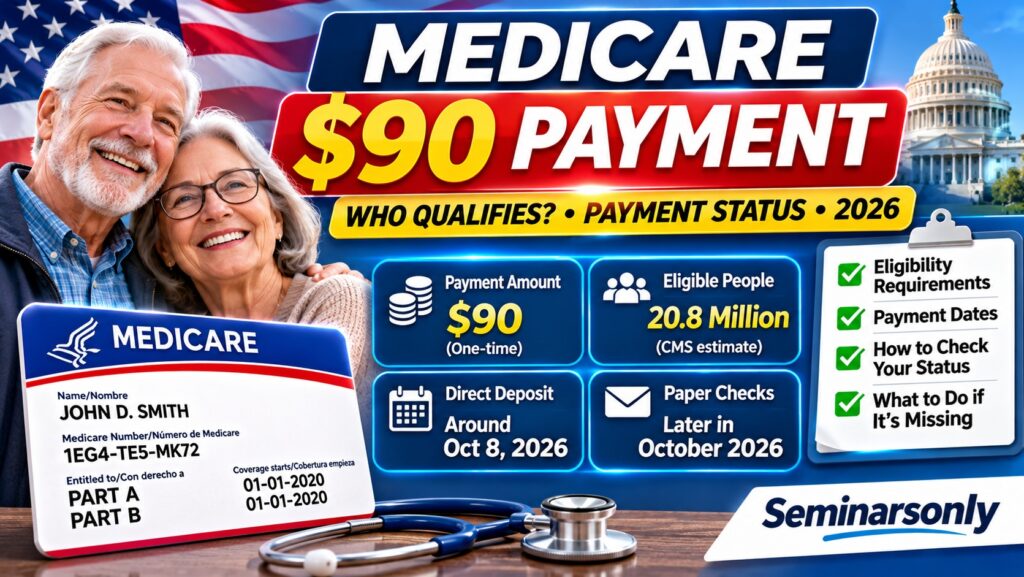
The federal government announced a one-time $90 Medicare Improvement Fund payment for approximately 20.8 million eligible beneficiaries in October 2026.
To qualify, you generally must have Original Medicare Part B, live in the United States, pay your Part B premium without Medicaid premium assistance, and not pay an income-related monthly adjustment amount (IRMAA).
CMS scheduled most direct deposits for around October 8, 2026, with Treasury paper checks later in October. Medicare Advantage members are excluded.
Eligibility: 1-800-MEDICARE (1-800-633-4227). Missing payment or deposit status: Social Security at 1-800-772-1213.
What Is the Medicare Improvement Fund $90 Payment?
The Medicare Improvement Fund Premium Rebate is a one-time federal payment designed to help qualifying Medicare beneficiaries offset part of their October 2026 Part B premium.
President Donald Trump announced the payment on October 2, 2026. The Centers for Medicare & Medicaid Services (CMS) published further instructions on October 3.
According to CMS, approximately 20.8 million Americans qualify under the program’s eligibility requirements.
The payment is not an additional monthly Social Security benefit. It is also not a permanent reduction in Medicare Part B premiums.
Eligible individuals receive $90 once, rather than $90 every month.
The Medicare Improvement Fund itself was established by Congress in 2008 to support improvements to Original Medicare.
The administration’s October 2026 rebate uses the fund to provide direct financial relief to certain beneficiaries.
Official source: CMS Medicare Improvement Fund Premium Rebate FAQ.
Medicare $90 Payment Dates: October and November 2026
CMS announced a payment schedule covering October 2026.
| Date | Payment Event | Who It Affects |
|---|---|---|
| October 2, 2026 | White House announces the $90 rebate | Potentially eligible Medicare beneficiaries |
| October 3, 2026 | CMS publishes payment and eligibility guidance | All beneficiaries seeking program information |
| Around October 8, 2026 | Most direct deposits scheduled | Eligible beneficiaries receiving payment electronically |
| Mid-October 2026 | Notification letter or email described by CMS | Beneficiaries receiving payment notifications |
| October 15, 2026 onward | SSA payment-status inquiries begin | Eligible people checking missing deposits |
| Later in October 2026 | Treasury paper checks expected | Eligible beneficiaries without direct deposit |
| November 2026 | No separate November payment announced | People following up on an October rebate |
The October 8 date was the approximate direct-deposit date announced by CMS, not a guarantee that every individual account would be credited on that day.
As of November 1, 2026, beneficiaries who believe they qualified but have not received their payment should contact the Social Security Administration for a status inquiry.
CMS has not described this rebate as a recurring November payment.
Who Qualifies for the Medicare Improvement Fund $90 Rebate?
The official CMS eligibility rules focus on the type of Medicare coverage a person has, their residence, and how their Part B premium is paid.
Eligible beneficiaries generally meet all of these conditions:
- They are enrolled in Original Medicare Part B.
- They live in the United States.
- They do not receive Medicaid assistance paying their Part B premium.
- They do not pay an Income-Related Monthly Adjustment Amount (IRMAA).
- They are not enrolled in Medicare Advantage.
The eligibility rules are narrower than simply being age 65 or older.
Some people with Medicare do not qualify, and receiving Social Security retirement benefits alone does not establish eligibility.
Medicare $90 Payment Eligibility Table
| Beneficiary Situation | Eligible? | Explanation |
|---|---|---|
| Original Medicare Part B, standard premium, living in the U.S. | Generally yes | Qualifies when the other program conditions are met |
| Medicare Advantage (Part C) | No | CMS explicitly excludes Medicare Advantage members |
| Medicaid pays the Part B premium | No | Premium assistance recipients are excluded |
| Higher-income beneficiary paying IRMAA | No | Income-related surcharge payers are excluded |
| Original Medicare Part B beneficiary living outside the U.S. | No | Program requires U.S. residence |
| Receiving Social Security retirement benefits | Depends | Social Security receipt alone is not sufficient |
| Original Medicare Part A only | No | The rebate is directed to eligible Part B enrollees |
If you are unsure whether your coverage qualifies, Medicare can verify your eligibility.
How Will the $90 Medicare Payment Arrive?
CMS described two payment methods: direct deposit and Treasury paper checks.
1. Direct Deposit
The majority of eligible beneficiaries were scheduled to receive the $90 rebate through the Social Security Administration’s direct-deposit system.
CMS identified approximately October 8 as the expected payment date for most electronic payments.
If you receive Social Security benefits through direct deposit, review your bank transactions for an additional $90 federal payment around that period.
The exact description shown by a bank can vary. Do not assume every unidentified $90 credit is this rebate without checking its source.
2. Paper Check
CMS stated that eligible beneficiaries without direct deposit would receive a check from the U.S. Department of the Treasury later in October.
The accompanying message was identified as:
Medicare Improvement Fund Payment
$90 Payment to Offset October Premium
Paper checks are sent to the mailing address registered with Medicare.
If your address has changed, contact Medicare or Social Security through their official channels to verify your records.
Why Did I Get $90 From Social Security?
If you received an unexpected $90 deposit in October 2026, it may be the Medicare Improvement Fund Premium Rebate.
Although the Social Security Administration is distributing most electronic payments, the rebate is associated with Medicare Part B.
It does not mean that your regular Social Security retirement benefit has permanently increased by $90.
It also should not be confused with the annual Social Security cost-of-living adjustment (COLA).
To identify a payment, review the transaction information and contact the appropriate federal agency if you need confirmation.
How to Check Medicare Improvement Fund Payment Status
If you expected the rebate but have not received it, begin by determining whether you satisfy the eligibility conditions.
Step 1: Verify Your Medicare Coverage
Check whether you have Original Medicare or Medicare Advantage.
If you are enrolled in Medicare Advantage, CMS says you are not eligible for this rebate.
Step 2: Check Who Pays Your Part B Premium
Review whether Medicaid or a Medicare Savings Program pays your Part B premium.
People whose Part B premiums are paid through Medicaid assistance are excluded under the published rules.
Step 3: Check for IRMAA
IRMAA is an additional Medicare premium amount charged to certain higher-income beneficiaries.
CMS excludes people paying this surcharge from the $90 rebate.
Step 4: Review Your Bank Account
Check transactions around October 8 and the following days for a possible $90 deposit.
If you normally receive federal benefits by mail, review your mail for a Treasury check.
Step 5: Call Medicare for Eligibility
Medicare phone number: 1-800-633-4227
TTY users can call 1-877-486-2048.
Ask whether your Medicare coverage and premium-payment situation satisfy the Medicare Improvement Fund Premium Rebate rules.
Step 6: Call Social Security for Payment Status
SSA phone number: 1-800-772-1213
CMS instructed beneficiaries to contact Social Security for payment-status inquiries beginning October 15, 2026.
When speaking with an agency representative, explain that you are asking about the one-time October 2026 Medicare Improvement Fund $90 rebate.
Use official telephone numbers and provide identifying information only after you have contacted the agency through a trusted channel.
What If My Medicare $90 Payment Is Missing in November?
Because the payment was scheduled for October, a missing rebate in November deserves a follow-up if you believe you qualify.
Before calling, check the following:
- Are you enrolled in Original Medicare Part B?
- Were you living in the United States under the eligibility rules?
- Did Medicaid pay your Part B premium?
- Were you paying an IRMAA surcharge?
- Were you enrolled in Medicare Advantage?
- Have you checked your October bank transactions?
- Is your mailing address current?
If you meet the criteria and still cannot locate the payment, contact Social Security at 1-800-772-1213.
Do not submit payment claims through websites advertising unofficial Medicare rebate applications.
Do Medicare Advantage Members Receive the $90 Payment?
No. The official CMS FAQ explicitly excludes Medicare Advantage enrollees.
Medicare Advantage, also known as Part C, is a way to receive Medicare coverage through a private plan approved by Medicare.
Although Medicare Advantage members generally remain enrolled in Parts A and B, the October 2026 rebate was limited to qualifying beneficiaries in Original Medicare Part B.
This distinction is important because having a Medicare card or paying a Part B premium does not automatically qualify someone for the rebate.
Do People With Medicaid Receive the $90 Rebate?
Beneficiaries whose Medicare Part B premiums are paid through Medicaid assistance are excluded.
That can include people receiving certain Medicare Savings Program benefits that pay their Part B premium.
The program is designed to offset premiums paid by qualifying individuals rather than duplicate assistance already covering those premiums.
If you have both Medicare and Medicaid but are uncertain who pays your premium, contact Medicare to verify your situation.
Does the $90 Payment Reduce Medicare Part B Premiums Permanently?
No. The $90 rebate is a one-time payment intended to offset part of the October 2026 premium.
It does not permanently change the monthly premium shown on your Medicare or Social Security records.
Future Medicare premiums are determined separately through the applicable federal rules and annual announcements.
Do not treat the rebate as a recurring addition to your monthly retirement income.
What Is the Medicare Improvement Fund?
The Medicare Improvement Fund was established by Section 7002 of the Supplemental Appropriations Act of 2008.
It appears in federal law at 42 U.S.C. § 1395iii, also known as Section 1898 of the Social Security Act.
The fund is intended to support improvements under Original Medicare Parts A and B.
In October 2026, the administration announced that the fund would be used to provide one-time $90 premium rebates to eligible beneficiaries.
The White House described the program as an effort to make Medicare more affordable for seniors.
The legal history and earlier congressional changes to the fund are separate from the practical question of whether an individual beneficiary qualifies for the October rebate.
Legal reference: 42 U.S.C. § 1395iii — Medicare Improvement Fund.
Is the Medicare $90 Payment a Scam?
The Medicare Improvement Fund rebate is a real federal program documented by CMS and Medicare.gov.
However, criminals may use real benefit announcements to create fake payment-registration websites, phishing messages and impersonation calls.
Be suspicious if someone contacts you unexpectedly and says you must:
- Pay a processing or release fee to receive $90.
- Provide your banking password or one-time security code.
- Purchase gift cards to verify your identity.
- Click an unfamiliar link to activate the rebate.
- Send your Medicare number through an unsolicited text message.
- Transfer money to a supposed government protection account.
The official program does not require beneficiaries to pay a fee to release the rebate.
Use Medicare.gov, CMS.gov or SSA.gov to verify information rather than relying on links in unsolicited messages.
For guidance, visit Social Security’s official scam prevention page.
Medicare $90 Rebate: Important Phone Numbers
| Agency | Phone Number | Reason to Call |
|---|---|---|
| Medicare | 1-800-633-4227 | Check rebate eligibility and Medicare coverage |
| Social Security Administration | 1-800-772-1213 | Ask about missing or undelivered payments |
| Medicare TTY | 1-877-486-2048 | TTY assistance with Medicare questions |
Official Sources for the Medicare Improvement Fund Rebate
- CMS — Medicare Improvement Fund Premium Rebate FAQ
- Medicare.gov — One-Time Premium Rebate Letter
- White House — October 2, 2026 Fact Sheet
- Social Security — Protect Yourself From Scams
- U.S. Code — Medicare Improvement Fund
Related Medicare and Social Security Guides
For additional government benefit and payment updates, visit Seminarsonly News.
Related topics to explore include Medicare premiums based on income, Medicare Savings Programs, Social Security payment dates and Medicare Advantage coverage.
Editorial note: Replace this section with direct internal links to verified published articles before publication.
TL;DR: Medicare Improvement Fund $90 Payment
- Payment amount: $90 per eligible beneficiary.
- Type: One-time Medicare Part B premium rebate.
- Eligible population: Approximately 20.8 million people.
- Direct deposits: Around October 8, 2026.
- Paper checks: Later in October 2026.
- Coverage: Qualifying Original Medicare Part B beneficiaries.
- Excluded: Medicare Advantage, Medicaid premium-assistance recipients, IRMAA payers and people living outside the U.S.
- Eligibility phone: 1-800-MEDICARE.
- Payment-status phone: 1-800-772-1213.
- November payment: No separate recurring payment announced.
Bottom line: The $90 Medicare Improvement Fund payment was a real, one-time federal rebate scheduled for October 2026. If you believe you qualify but have not received it, verify your eligibility with Medicare and contact Social Security about payment status.
Editorial disclosure: This article is an independent informational guide, not a government website. Information was checked against official CMS, Medicare.gov, White House and Social Security resources on November 1, 2026. Individual eligibility and payment records can only be confirmed by the responsible agencies.