
How Many Bear Species Are There : Eight (8) Bear Species of the World
Bears are carnivoran mammals of the family Ursidae. They are classified as caniforms, or doglike carnivorans. Although only eight species of bears are extant, they are widespread, appearing in a wide variety of habitats throughout the Northern Hemisphere and partially in the Southern Hemisphere.
Bears are found on the continents of North America, South America, Europe, and Asia. Common characteristics of modern bears include large bodies with stocky legs, long snouts, small rounded ears, shaggy hair, plantigrade paws with five nonretractile claws, and short tails.
https //ballysports.con/activate Code Login : Activate Bally Sports on Android or Smart TV
There are Eight (8) Bear Species of Bear in the World
| Common name | Scientific name and subspecies | Range | Size and ecology | IUCN status and estimated population |
|---|---|---|---|---|
Giant panda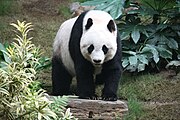 |
A. melanoleuca David, 1869 hide Two subspecies
|
Central China |
Size: 150–180 cm (59–71 in) long, plus 10–15 cm (4–6 in) tail 80–123 kg (176–271 lb)[4][5]Habitat: Forest[6] Diet: Eats only bamboo[6] |
VU 500–1,000 |
Subfamily Tremarctinae[edit]
| Common name | Scientific name and subspecies | Range | Size and ecology | IUCN status and estimated population |
|---|---|---|---|---|
Spectacled bear |
T. ornatus F. Cuvier, 1825 |
Andes mountains in South America |
Size: 120–200 cm (47–79 in) long, plus 7 cm (3 in) tail 60–175 kg (132–386 lb)Habitat: Shrubland, grassland, and forest[8] Diet: Primarily eats bromeliads and palm trees, as well as cattle, other mammals, and fruit[8] |
VU 2,500–10,000 |
Subfamily Ursinae[edit]
| Common name | Scientific name and subspecies | Range | Size and ecology | IUCN status and estimated population |
|---|---|---|---|---|
Sun bear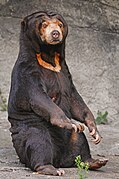 |
H. malayanus Raffles, 1821 hide Two subspecies
|
Southeast Asia (current range in brown, former in black)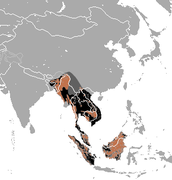 |
Size: 120–150 cm (47–59 in) long, plus 3–7 cm (1–3 in) tail 35–80 kg (77–176 lb)[9][10]Habitat: Forest and shrubland[11] Diet: Primarily eats termites, ants, beetle larvae, bee larvae, honey, and fruit[11] |
VU 50,000 |
| Common name | Scientific name and subspecies | Range | Size and ecology | IUCN status and estimated population |
|---|---|---|---|---|
Sloth bear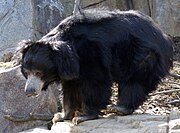 |
M. ursinus Shaw, 1791 hide Two subspecies
|
India (current range in green, former in black) |
Size: 150–180 cm (59–71 in) long, plus 7–12 cm (3–5 in) tail 54–141 kg (119–311 lb)Habitat: Shrubland, grassland, forest, and savanna Diet: Primarily eats termites and fruit |
VU 6,000–11,000 |
| Common name | Scientific name and subspecies | Range | Size and ecology | IUCN status and estimated population |
|---|---|---|---|---|
American black bear |
U. americanus Pallas, 1780 show Sixteen subspecies
|
North America (current range in red, former in pink) |
Size: 120–200 cm (47–79 in) long, plus 8–14 cm (3–6 in) tail 39–409 kg (86–902 lb)[16]Habitat: Forest, inland wetlands, grassland, shrubland, and desert[17] Diet: Omnivorous; eats vegetation, roots, buds, fruit, nuts, insects, fish, mammals, and carrion[17] |
LC 735,000–941,000 |
Asian black bear |
U. thibetanus Cuvier, 1823 show Seven subspecies
|
South and East Asia (current range in brown, former in black) |
Size: 120–180 cm (47–71 in) long, plus 6–11 cm (2–4 in) tail 65–150 kg (143–331 lb)[19]Habitat: Forest, inland wetlands, grassland, and shrubland[20] Diet: Eats vegetation, insects, fruit, nuts, ungulates, and livestock[20] |
VU 50,000 |
Brown bear |
U. arctos Linnaeus, 1758 show Sixteen subspecies
|
Northern North America and Europe, and northern and central Asia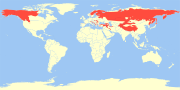 |
Size: 100–280 cm (39–110 in) long, plus 6–20 cm (2–8 in) tail 80–550 kg (176–1,213 lb)[21]Habitat: Desert, forest, inland wetlands, grassland, and shrubland[22] Diet: Omnivorous; eats grasses, herbs, roots, berries, nuts, insects, mammals, and fish |
LC 110,000 |
Polar bear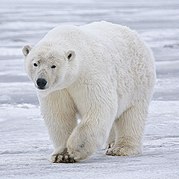 |
U. maritimus Mulgrave, 1774 |
Polar North America and Asia |
Size: 220–244 cm (87–96 in) long, plus 7–13 cm (3–5 in) tail 408–726 kg (900–1,600 lb)Habitat: Marine oceanic, shrubland, forest, grassland, marine coastal/supratidal, and marine intertidal Diet: Primarily eats seals, as well as walruses, beluga whales, birds, fish, vegetation and kelp[24] |
VU 23,000 |
