
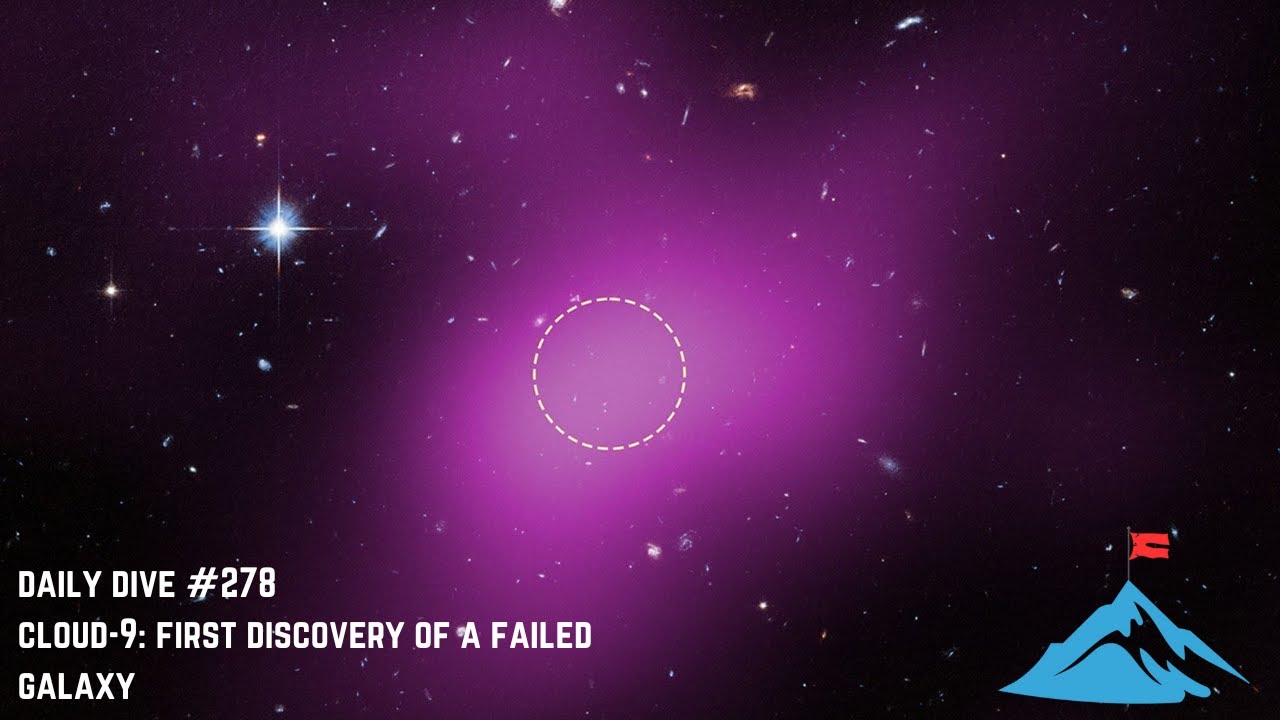
⚡ Quick Answer: What is Cloud-9?
- A Starless Anomaly: The failed galaxy candidate Cloud 9 is a massive space cloud entirely devoid of stars, consisting mainly of neutral hydrogen gas and dark matter.
- Classification: It is officially classified as a RELHIC (Reionization-Limited H I Cloud).
- Massive Proportions: While it holds about 1 million solar masses of hydrogen, its dark matter halo is estimated at a staggering 5 billion solar masses.
- Location: It sits approximately 14 million light-years from Earth, located near the spiral galaxy Messier 94 (M94).
When we look up at the night sky, we expect galaxies to be glowing metropolises of stars. However, modern astronomy has just thrown a curveball. The failed galaxy candidate Cloud 9 has officially been confirmed as a first-of-its-kind astronomical object: a galaxy with the necessary raw materials to form stars, but which never actually birthed a single one.
Confirmed by NASA’s Hubble Space Telescope in early 2026, this “dark” galaxy is reshaping our understanding of the early universe, dark matter halos, and cosmological evolution. Here is everything you need to know about this fascinating discovery.
Why Did Cloud-9 Fail to Form Stars?
To understand why this massive cloud of hydrogen is considered a “failed galaxy,” we have to look back at the early stages of the universe. Cloud-9 is classified as a RELHIC (Reionization-Limited H I Cloud).
- Cosmic Heating: During the epoch of reionization, ultraviolet background radiation permeated the universe. This intense radiation heated the gas in low-mass dark matter halos to extreme temperatures.
- Inability to Cool: Because the hydrogen gas became too hot, it could not efficiently cool down and collapse into dense cores.
- No Stellar Ignition: Without that gravitational collapse, nuclear fusion could never begin, leaving Cloud-9 as a pristine, starless gas cloud trapped in a massive dark matter halo.
The Discovery: From FAST to Hubble
Finding an object that emits no starlight is incredibly difficult. The failed galaxy candidate Cloud 9 was not found by looking for light, but by listening for radio waves.
| Telescope | Role in Discovering Cloud-9 |
|---|---|
| FAST (China) | Initially detected the compact hydrogen (H I) cloud via radio observations in 2023. |
| VLA & GBT (USA) | The Very Large Array and Green Bank Telescope provided independent confirmation of the radio signals. |
| Hubble Space Telescope | Used its Advanced Camera for Surveys in 2026 to confirm the absolute absence of any stars, proving it was a failed galaxy. |
What Cloud-9 Tells Us About Dark Matter
Perhaps the most exciting aspect of the failed galaxy candidate Cloud 9 is what it reveals about the invisible universe. Standard cosmological models (specifically the Lambda Cold Dark Matter model) have long predicted that there should be countless small, starless dark matter halos scattered across the universe.
Because Cloud-9 contains about 1 million solar masses of gas but remains gravitationally bound, scientists calculate that its underlying dark matter framework must weigh roughly 5 billion times the mass of our Sun. This discovery finally provides empirical, observational proof that these predicted “dark” structures exist in our local universe.
The Final Takeaway
- The failed galaxy candidate Cloud 9 proves that a galaxy does not need stars to exist; it only needs a massive dark matter halo and primordial gas.
- Finding RELHICs observationally is incredibly difficult because nearby bright objects outshine them, making Cloud-9 a rare window into the early universe.
- As telescopes like Hubble and FAST continue to scan the skies, scientists expect to find many more of these “dark” galaxies, bringing us closer to understanding the true nature of dark matter.
