
Last updated: July 16, 2026 | Written by Freddy John
Quick answer
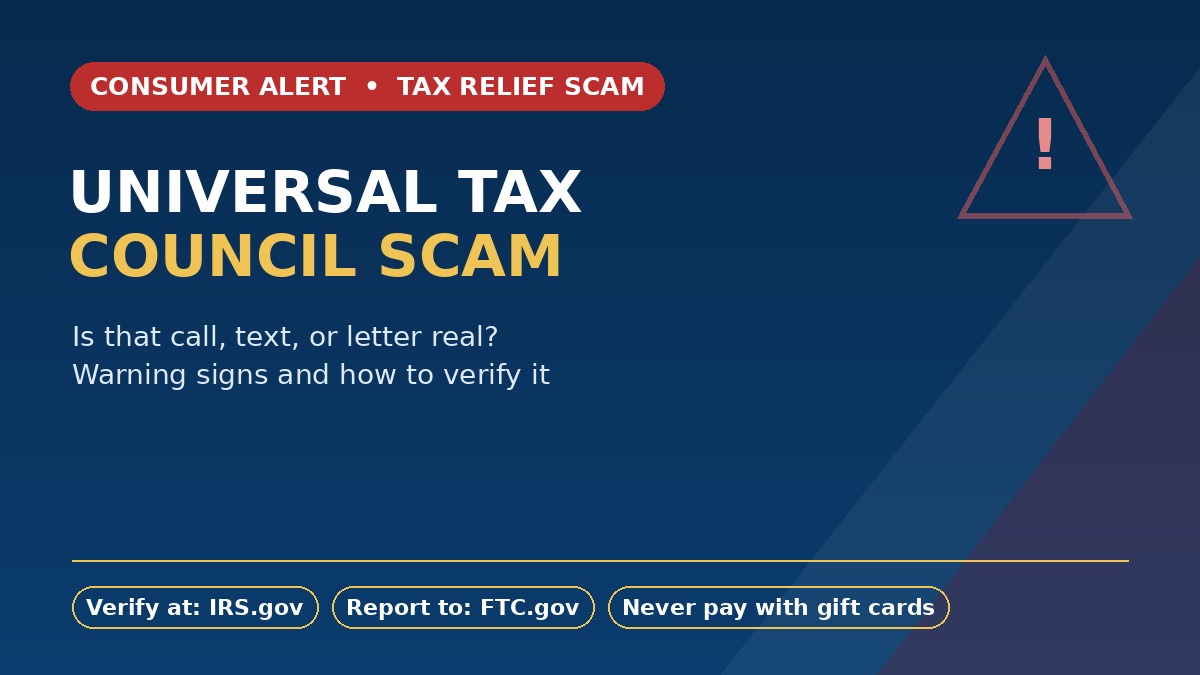
We could not find an official FTC, BBB, or IRS alert specifically naming “Universal Tax Council” as a confirmed scam. That does not automatically mean it is legitimate. The name fits a well-documented pattern of official-sounding, fake tax relief entities that regulators have confirmed, like “Tax Resolution Oversight Department” and the “Bureau of Tax Enforcement.” If you were contacted by this name, do not call back the number they gave you. Verify independently using the steps below.
TLDR: What to do right now
- The real IRS contacts you about a new issue by mail first, never by surprise phone call, text, or email.
- Never pay anyone claiming to be tax-related using gift cards, wire transfer, or cryptocurrency.
- Do not use the phone number or link the caller, text, or email gave you to “verify” anything.
- Look up the exact name independently: BBB Scam Tracker, your state Attorney General, and IRS.gov.
- Report suspicious contact to the FTC at ReportFraud.ftc.gov and to phishing@irs.gov.
- Do not confuse this with unrelated, established businesses that happen to share similar naming.
On this page
What we found when we checked this name
We checked the FTC’s consumer alert database, the Better Business Bureau, and the IRS’s own scam and phishing pages for an entity specifically named “Universal Tax Council.” As of this writing, we found no official alert tied to that exact name.
Important points to keep in mind
- No official alert does not automatically mean a contact is safe. Scam names and phone numbers rotate constantly and often outpace regulator databases.
- Regulators have confirmed a broader pattern this name fits: official-sounding but fake tax relief or enforcement entities, including “Tax Resolution Oversight Department,” the “Bureau of Tax Enforcement,” and “Tax Mediation and Resolution Agency.”
- There are separate, established businesses with similar naming, including Universal Tax Group and Universal Tax Professionals, both listed with the Better Business Bureau. These are not confirmed to be connected to “Universal Tax Council” in either direction, so do not assume either way based on the name alone.
- The only reliable way to know is to verify the specific name, number, and details you were given, using the steps further down this page.
How this type of scam typically works
According to the FTC and FCC, the current wave of tax relief scams follows a consistent script, regardless of which invented company name is used.
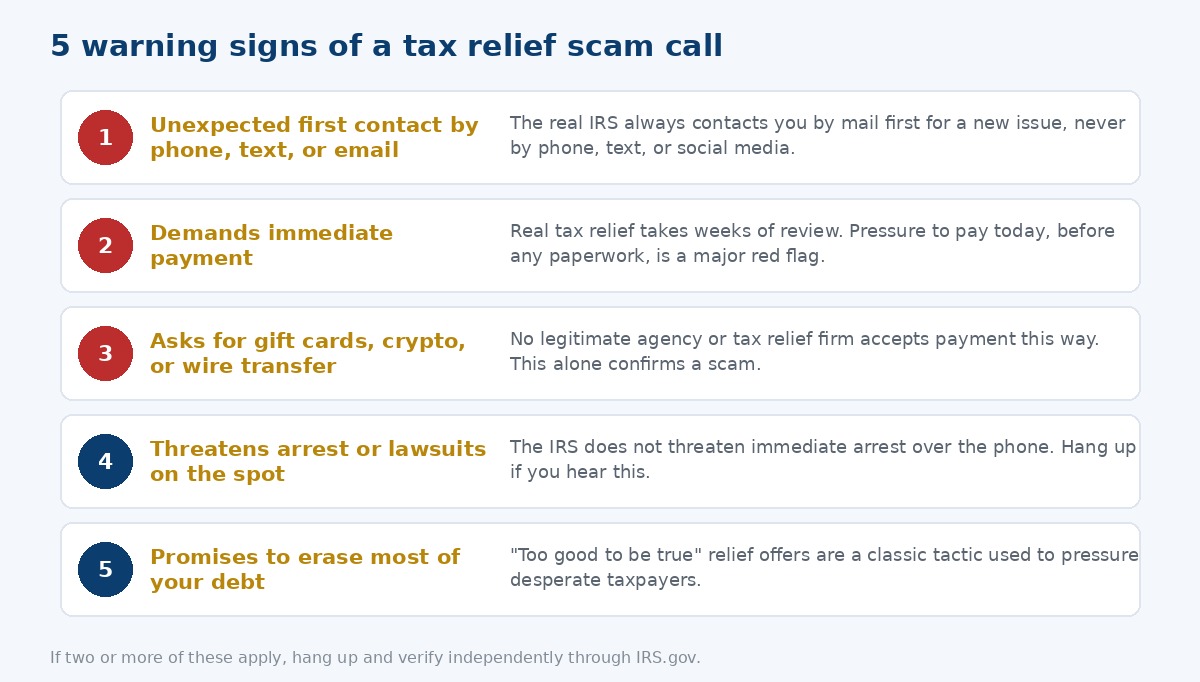
- An unexpected call, voicemail, or text claims you owe back taxes or missed a filing.
- The caller offers to connect you with a “tax resolution officer” or enroll you in an “IRS liability reduction program,” terms that are not real IRS programs.
- They create urgency, sometimes saying “this may be our only attempt to reach you,” to get you to call back before thinking it through.
- If you engage, they ask for personal or financial information, or request payment through gift cards, wire transfer, or cryptocurrency.
- Legitimate tax debt relief is a slow process involving real paperwork with the IRS. It is never resolved in a single urgent phone call.
Red flags to watch for
| If you see this | What it usually means |
|---|---|
| Surprise call, text, or email about back taxes | Not how the IRS makes first contact on a new issue. Treat as a scam. |
| Requests payment by gift card, crypto, or wire | No legitimate agency accepts these. Automatic scam confirmation. |
| Threatens immediate arrest or lawsuit | The IRS does not threaten arrest over the phone. |
| Promises to erase most or all of your debt | A classic too-good-to-be-true pressure tactic. |
| Gives you a callback number instead of a public one | Real agencies are reachable through numbers listed on their own official site, not one dictated to you. |
How to verify a tax contact yourself
- Do not call the number left in the voicemail, text, or email. Look up contact details independently.
- Search the exact company name plus “BBB Scam Tracker” and plus “reviews” separately, since scam names and legitimate business names can look similar.
- Call the IRS directly using the number listed on IRS.gov to confirm whether you actually have an outstanding balance.
- If a private collection agency is genuinely involved, the IRS will have sent you a letter first identifying that specific agency by name before it ever calls you.
- If in doubt, involve a licensed, independently verified tax professional or your state Attorney General’s consumer protection office rather than anyone who contacted you first.
If you already responded or paid
- Contact your bank or card issuer immediately to flag or reverse the transaction if possible.
- Report the scam to the FTC at ReportFraud.ftc.gov.
- Report it to the Treasury Inspector General for Tax Administration, and forward any suspicious email to phishing@irs.gov.
- If you shared a Social Security number or other sensitive identifiers, consider placing a fraud alert or credit freeze with the major credit bureaus.
Remember: the real IRS will never ask you to pay with gift cards, cryptocurrency, or a wire transfer, and it will not threaten immediate arrest over the phone. Either of these alone is enough to hang up.
Frequently asked questions
Is Universal Tax Council a scam?
There is no official FTC, BBB, or IRS alert naming this exact entity as of this writing. It matches a well-documented pattern of fake tax relief names regulators have confirmed elsewhere, so verify independently rather than assuming either way.
Does the IRS call, text, or email about back taxes?
No. First contact on a new issue is always by mail, never by phone, text, email, or social media, and never with a demand for immediate gift card or crypto payment.
How can I verify a tax relief company is legitimate?
Look them up independently using BBB Scam Tracker and the IRS’s own directory, and call the IRS directly through the number on IRS.gov rather than any number the contact gave you.
What should I do if I already gave out information or paid?
Contact your bank immediately, report it to the FTC at ReportFraud.ftc.gov, and report it to the Treasury Inspector General for Tax Administration.
Is Universal Tax Council the same as Universal Tax Group or Universal Tax Professionals?
Not necessarily. Those are separate, established businesses with public BBB profiles. Do not assume a connection in either direction based on naming alone; verify the exact name and details you were given.
You can cross-check any suspicious number against our own Scam Number Tracker, or browse our full Consumer Scams section for more verified guides. For official guidance, see the FTC’s tax scam consumer alert and the IRS’s guide to reporting fake IRS contact.
