

Published on Feb 14, 2025
With alternatives to petrol engine being announced ever so often, we could be forgiven for thinking that the old favorite, the petrol engine, is on its last legs. But nothing could be further from the truth and the possibilities for developing the petrol engine are endless.
One of the most crucial jobs on the agenda is to find ways of reducing fuel consumptions, cutting emissions of the green house gas, co2, and also the toxic emissions which threaten air quality. One such fast emerging technology is cylinder deactivation.
By considering Daimler Chrysler's new 300cc car's powered by a revival of one of the greatest muscle car engine of all time, the V8 Hemi. This third generation grand master of funk has a capacity of 5.7litres snorts out 340 bhp with 54kgm torque and like all Hemis since the early 1950's has a pushrod valve train rather than a over head cam setup. But even though this Hemi can match its forebears on power 'its thirst for fuel has been cut by 10 to 20%. It is done by Chrysler's new multi displacement system (mds).
When using a lot of power, such as during acceleration, the hemi fires on all eight cylinders as usual. But around town or when cruising -even at motor way speeds or under gentle acceleration-the engine switches to frugal four cylinder mode.
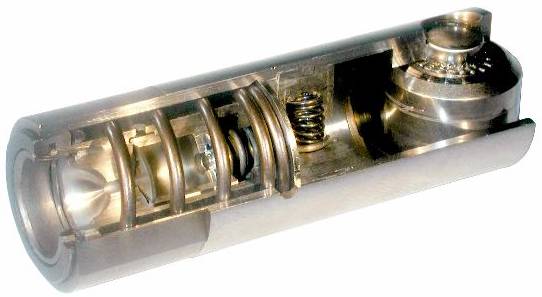
Multi displacement system (mds) is activated at part throttle between 1000 rpm and 3000 rpm, when a hydraulically actuated catch in the special valve lifters trips to prevent the valves from opening. Hot gases are trapped in four of the eight cylinders, compressing and expanding like giant air springs as the engine turns over and keeping the cylinder warm. But as long as the valves remain closed, only four cylinders consume fuel instead of eight.
Engine efficiency is also improved because the four dormant cylinders are no longer working hard at sucking air into the engine, something that consumes a substantial amount of power. Although the average fuel saving is 10% ,under certain conditions it is a huge 20%.The transition from eight cylinders to four cylinders happens in just 40 mille seconds under the control of sophisticated engine management software which controls not just the multidisplacement system but also a drive-by-wire throttle.
IN Japan the 3.0 liter I-VTEC (intelligent VTEC) V6 of the Honda inspire can also deactivate tree of its first cylinders refinement being guaranteed by active hydraulic engine mounts to cancel out any vibration and active noise control with in the cabin to neutralize any unwanted booming. Honda's CIVIC IMA hybrid also make use of V TEC to deactivate three cylinders on the over run-again to reduce the pumping losses and cut fuel consumption
The actual idea of cylinder deactivation is not new. General Motors tried it in 1981 with the V-8-6-4 engine but through lack of sophisticated electronics drivability was awful. Now GM is returning to the idea again and is to soon launch Displacement on Demand (DOD} on itsVortecV 8's improving consumption by between 6 and 8%.
LOTUS has been working on cylinder deactivation for a number of years. They first built a demonstrator model sometimes ago based on a 1.8 litre GM engine. They achieve a 12 % fuel consumption improvement through the drive cycle which amounts to a significant fuel saving in the real world. They were also able to run the engine on two cylinders at 112Kph. The benefits of cylinder deactivation increases with the engines capacity and the power to weight ratio of the car.
There is a huge secondary benefit to be had through a reduction in the main toxic emissions on which global emissions regulations are based – unburned hydrocarbons (HC), Oxides of Nitrogen (NOx) and Carbon Monoxide (CO).
Being able to time the timing and lift of valves to an infinite degree creates immense possibilities. One such example is controlled auto ignition (CAI). It works in absence of one crucial independent-spark. Instead of the usual sparkplug, firing at a carefully timed moment to set the compressed charge of fuel alight, compressed auto ignition instead work by trapping a portion of hot exhaust gases from the previous cycle, their heat igniting the incoming fuel spontaneously.
This is done by trapping the exhaust gases in the cylinder and with active valve train, by closing the exhaust valve early on the exhaust stroke before all the exhaust gases has been expelled. The trapped gases are compressed and expand again as the piston goes over top dead centre. At the same time the inlet valve opens to let the fuel and air, which mixes with hot gas. When the compression stroke follows as normal, the mixture ignites automatically.
At idle speeds, compressed auto ignition is less effective because exhaust gas temperature are low and so it is necessary to revert to a spark. Hence change to spark ignition at idle speeds. At compressed auto ignition engine out NOx is reduced by more than 90% compared to a conventional spark ignition petrol engines.
Lotus which has been working on cylinder deactivation since the late 1990’s, has high hope for its future. Current deactivation systems work by mechanically disabling the inlet and exhaust valves, but things could become simpler in future cam less engines. Lotus Active Valve Train (AVT) technology is still at the research stage and does away with camshafts altogether. Instead, the valves are operated by high-speed hydraulic actuators allowing infinitely variable valve timing and lift.AVT is expected to appear on a production car for the first time in 2008.renault has also experimented with cam less valve train using sprigs and solenoids.
If we deactivate half the cylinders, the other half are operating at twice the net load to provide the same amount of power out put from the engine. So throttle losses on those cylinders are reduced because they are running at a higher load and combustion is stronger.
The other major toxic emission, NOx, can be controlled by funneling exhaust into the inlet tract—a process called exhaust gas recirculation NOx is generated by a combination of higher temperature and oxygen. So be reducing the amount of oxygen in the combustion process with Exhaust Gas Recirculation, NOx is reduced. More potent combustion also results in a reduction of co, so cylinder deactivation wins on all account.
Delphi Automotive systems’ cylinder deactivation is an advanced fuel economy-boosting system that selectively ‘turns off’ half of the engine’s cylinders under certain driving conditions. The engine continues to be even firing on the remaining cylinders
With an eight-cylinder petrol engine, for example, Delphi’s cylinder deactivation system ‘turns off’ four of the cylinders any time there is a light load on the including highway cruising at moderate speeds and driving around town at lower speeds.
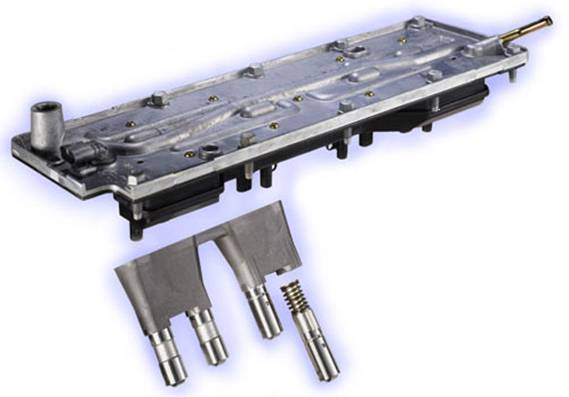
The system is available for two types of petrol, port-fuel injected engines: the pushrod and overhead cam (OHC) valve trains. Controlled by the engine control module (ECM), the system automatically switches between eight and four cylinders as load and RPM parameters change.
The system precisely closes the intake and exhaust valves with in the target cylinders. An ECM-controlled actuator is used to disable the valves, using either hydraulic (oil) pressure or electric solenoids. This actuator makes the deactivation device turn ‘on; and ‘off’ the valves. The deactivation takes place in the valve lifters on a push rod engine and the rocker arms on an over head cam engine.
While each cylinder deactivation system is unique to the customer’s application and other driving conditions, fuel economy is expected to improve by eight to ten percentages.
Delphi’s cylinder deactivation system is now being prepared for production. The technology is also applicable to midsize six cylinder engine applications
| Are you interested in this topic.Then mail to us immediately to get the full report.
email :- contactv2@gmail.com |
